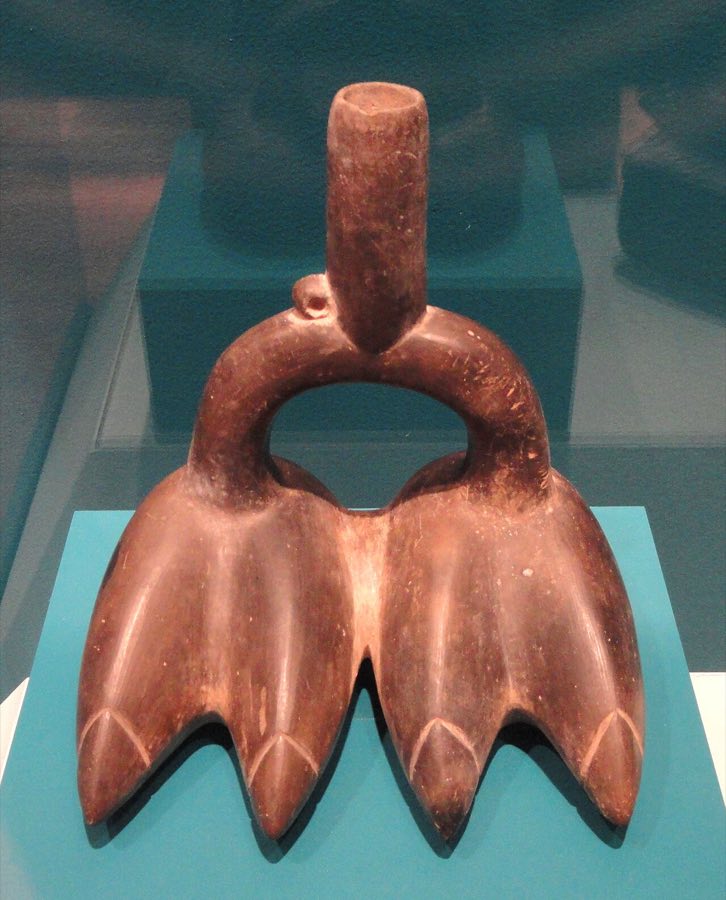

Vessel · Late Intermediate Period
Chimú blackware vessel
1000–1470 CE, Chimú
Chimú workshops at Chan Chan and across Peru's north coast produced blackware in huge numbers from about 1000 CE until the Inca conquest around 1470, using moulds for both the body and the relief decoration. Common motifs are fish, birds, waves, crescent-headdressed figures and animal effigies; whistling double vessels are a favourite. Blackware is the most abundant and affordable Andean ceramic on the market, and export from Peru is prohibited.
| Object | Vessel |
|---|---|
| Dates | 1000–1470 CE |
| Period | Late Intermediate Period |
| Cultures | Chimú |
| Regions | South America — Andes |
Diagnostic traits
A mould-made, reduction-fired black or dark grey burnished vessel, usually a stirrup-spout or double-chambered bottle, with a small modelled monkey or bird at the base of the spout and press-moulded relief scenes on the body.
Identification
The reduced black fabric, moulded relief and spout monkey are diagnostic; Moche vessels are oxidised cream-and-red, Lambayeque (Sicán) blackware is earlier with a distinctive lord's face at the spout, and Inca-Chimú vessels show Inca shapes such as the aryballos in Chimú black fabric.
Reproductions and fakes
Modern reproductions are made in Trujillo and Lima from moulds taken off originals and reduction-fired, so shape alone is no guide; genuine vessels show wear on the base, a dull sheen, mineral deposits inside and an uneven blackening from firing. Thermoluminescence is decisive.
Cite this article
Stratum Study. "Chimú blackware vessel" (Artifact type). Stratum Study pack 2026.09, as of 2026-09-21. https://stratum.black/study/types/chimu-blackware-vessel. Accessed 2026-09-21.
@misc{stratum-chimu-blackware-vessel,
  title        = {Chimú blackware vessel},
  author       = {{Stratum Study}},
  howpublished = {\url{https://stratum.black/study/types/chimu-blackware-vessel}},
  year         = {2026},
  note         = {Artifact type article, Stratum Study pack 2026.09, as of 2026-09-21; sources: stratum, commons. Accessed 2026-09-21.}
}
Citations carry the pack version and the article's as-of date so they resolve to the same text later. The facts themselves belong to the sources listed below; cite those for the science.