
Site · United Kingdom
Stonehenge
Bell Beaker, 3000–1600 BCE
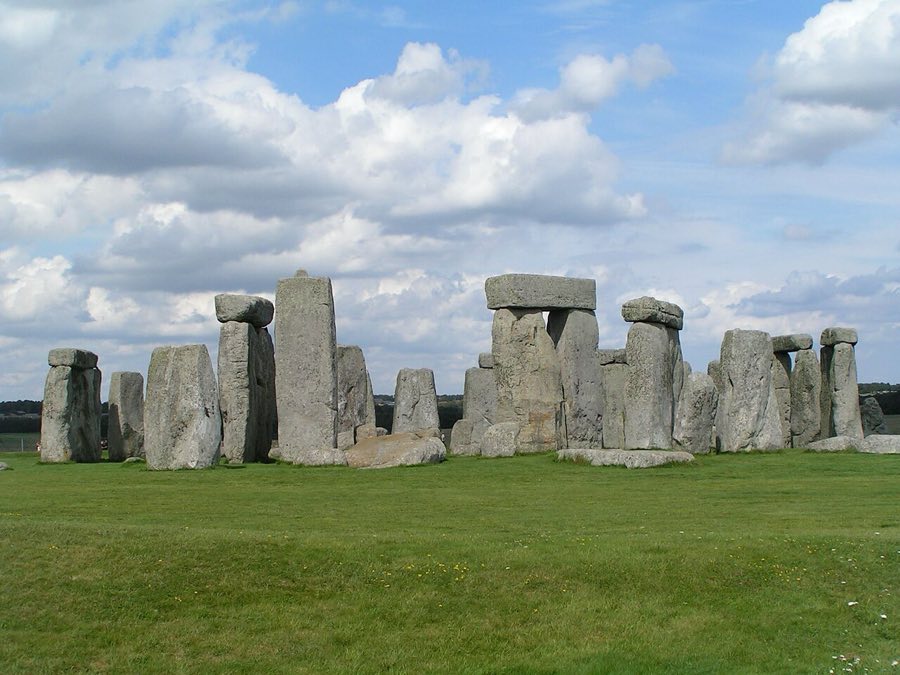
Stonehenge is the prehistoric stone circle on Salisbury Plain, built in stages from about 3000 to 1600 BCE with sarsens from the Marlborough Downs and bluestones from Wales, aligned on the solstices. It is the most famous prehistoric monument in Europe.
| Country | United Kingdom |
|---|---|
| State / province | Wiltshire |
| Dates | 3000–1600 BCE |
| Status | Scheduled Monument and UNESCO World Heritage Site |
| Managed by | English Heritage on National Trust land |
| Access | Open to the public with a visitor centre; the stone circle is viewed from a path |
| Coordinates | 51.179, -1.826 (public site) |
What was found
Excavations recovered cremations in the Aubrey Holes, Beaker burials such as the Stonehenge Archer, antler picks, bluestone chips, Grooved Ware and Beaker pottery, and the nearby Amesbury Archer and Bush Barrow grave groups. Most finds are in the Salisbury and Wiltshire museums.
Rules
Nothing may be collected, dug, moved or removed at Stonehenge; it is a protected archaeological site managed by English Heritage on National Trust land, and taking artifacts, stones or samples is an offence. In England, Scheduled Monument protection makes any digging or metal detecting without consent an offence. This article is for study and context only and is not a collecting locality.
Elsewhere
Cite this article
Stratum Study. "Stonehenge" (Site). Stratum Study pack 2026.09, as of 2026-09-21. https://stratum.black/study/sites/stonehenge. Accessed 2026-09-21.
@misc{stratum-stonehenge,
  title        = {Stonehenge},
  author       = {{Stratum Study}},
  howpublished = {\url{https://stratum.black/study/sites/stonehenge}},
  year         = {2026},
  note         = {Site article, Stratum Study pack 2026.09, as of 2026-09-21; sources: stratum, wikidata, commons. Accessed 2026-09-21.}
}
Citations carry the pack version and the article's as-of date so they resolve to the same text later. The facts themselves belong to the sources listed below; cite those for the science.