
Site · United States
Grave Creek Mound
Adena, 250–150 BCE
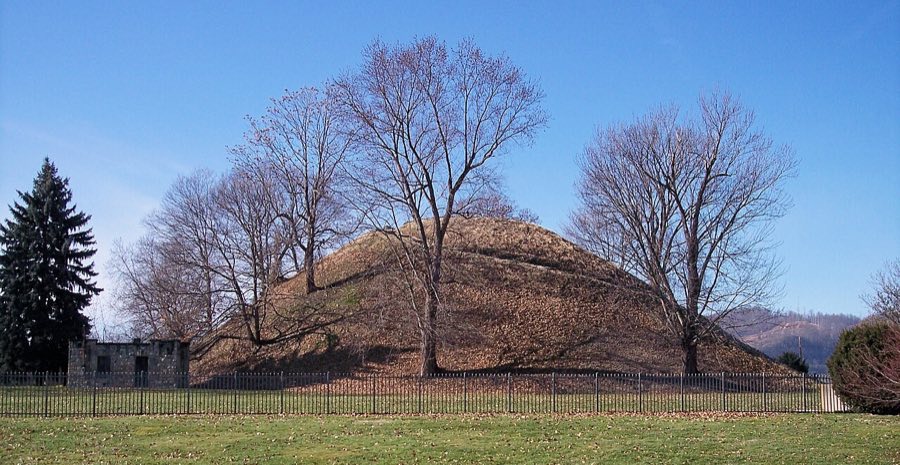
At about 62 feet high and 240 feet across, Grave Creek is the largest conical burial mound of the Adena culture, built in stages around 250–150 BCE on the Ohio River terrace and once surrounded by a ditch. It was a landmark to early travellers and was nearly destroyed by amateur digging and a saloon before the state acquired it in 1909.
| Country | United States |
|---|---|
| State / province | West Virginia |
| Dates | 250–150 BCE |
| Status | State Archaeological Complex and National Historic Landmark |
| Managed by | West Virginia Department of Arts, Culture and History |
| Access | The mound and the Delf Norona Museum in Moundsville are open Tuesday to Saturday, with a path to the summit of the mound. |
| Coordinates | 39.916, -80.744 (public site) |
What was found
An 1838 tunnel by local landowners reached two log-lined burial vaults with several skeletons, copper bracelets, shell beads and mica, and produced the notorious Grave Creek Stone, an inscribed tablet now regarded as a nineteenth-century hoax.
Rules
Nothing may be collected or disturbed; West Virginia Code protects archaeological sites on state land and unmarked graves, and federal NAGPRA applies to the collections. This article is for study and context only and is not a collecting locality.
Elsewhere
Cite this article
Stratum Study. "Grave Creek Mound" (Site). Stratum Study pack 2026.09, as of 2026-09-21. https://stratum.black/study/sites/grave-creek-mound. Accessed 2026-09-21.
@misc{stratum-grave-creek-mound,
  title        = {Grave Creek Mound},
  author       = {{Stratum Study}},
  howpublished = {\url{https://stratum.black/study/sites/grave-creek-mound}},
  year         = {2026},
  note         = {Site article, Stratum Study pack 2026.09, as of 2026-09-21; sources: stratum, wikidata, commons. Accessed 2026-09-21.}
}
Citations carry the pack version and the article's as-of date so they resolve to the same text later. The facts themselves belong to the sources listed below; cite those for the science.