
Culture · Early Woodland
Adena
1000 BCE–100 CE, North America — Eastern Woodlands
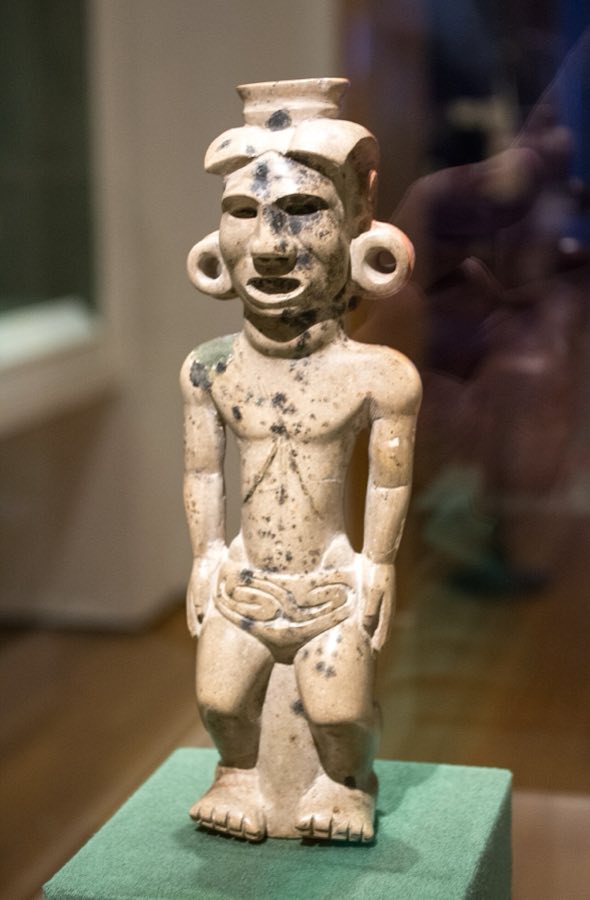
Adena is the Early Woodland mound-building culture of the Ohio Valley, Kentucky, West Virginia and adjacent states, dated to roughly 1,000 BCE to 100 CE. It built conical burial mounds and circular earthworks and produced some of the first pottery and tobacco pipes in the region. Collectors hold Adena stemmed points, leaf-shaped blades, two-hole gorgets, tubular pipes, birdstones and occasional engraved tablets.
| Dates | 1000 BCE–100 CE |
|---|---|
| Period | Early Woodland |
| Region | North America — Eastern Woodlands |
| Areas | Ohio Valley, Kentucky, West Virginia, Indiana |
| Typical objects | Projectile point, Gorget, Pipe, Birdstone, Vessel |
| Typical materials | Flint Ridge flint, Upper Mercer chert, Banded slate, Native copper |
Identification
Adena points have ovate blades and long rounded stems, frequently in Flint Ridge flint, and Adena blades are large and leaf-shaped. Ground-slate gorgets in rectangular, reel and expanded-centre shapes, tubular blocked-end pipes, and cache blades in Upper Mercer chert are all characteristic. Pottery is thick, grit-tempered and cordmarked or plain.
Legality
In the United States, prehistoric artifacts may be collected and sold only when they come from private land with the landowner's permission; removal from federal, tribal or most state land is prohibited under ARPA and state statutes. Funerary objects, human remains and sacred items are covered by NAGPRA and are not legitimately traded, and Canadian provinces treat archaeological finds as Crown or provincial property. Most classic Adena objects came from mound burials and are thus funerary objects under NAGPRA, which makes unprovenienced pipes and tablets a legal and ethical risk.
Reproductions and fakes
Adena tubular pipes and engraved tablets are faked, the tablets in particular because so few genuine ones exist. Fake pipes show rotary drill striations rather than the irregular reaming of a genuine bore and often have a uniform pipestone that does not match Ohio sources. Two-hole gorgets are also made from modern slate and given a thin polish.
Elsewhere
- Wikidata: Q355841
- Wikipedia: Adena culture
Cite this article
Stratum Study. "Adena" (Culture). Stratum Study pack 2026.09, as of 2026-09-21. https://stratum.black/study/cultures/adena. Accessed 2026-09-21.
@misc{stratum-adena,
  title        = {Adena},
  author       = {{Stratum Study}},
  howpublished = {\url{https://stratum.black/study/cultures/adena}},
  year         = {2026},
  note         = {Culture article, Stratum Study pack 2026.09, as of 2026-09-21; sources: stratum, wikidata, commons. Accessed 2026-09-21.}
}
Citations carry the pack version and the article's as-of date so they resolve to the same text later. The facts themselves belong to the sources listed below; cite those for the science.