
Site · Turkey
Göbekli Tepe
9500–8000 BCE
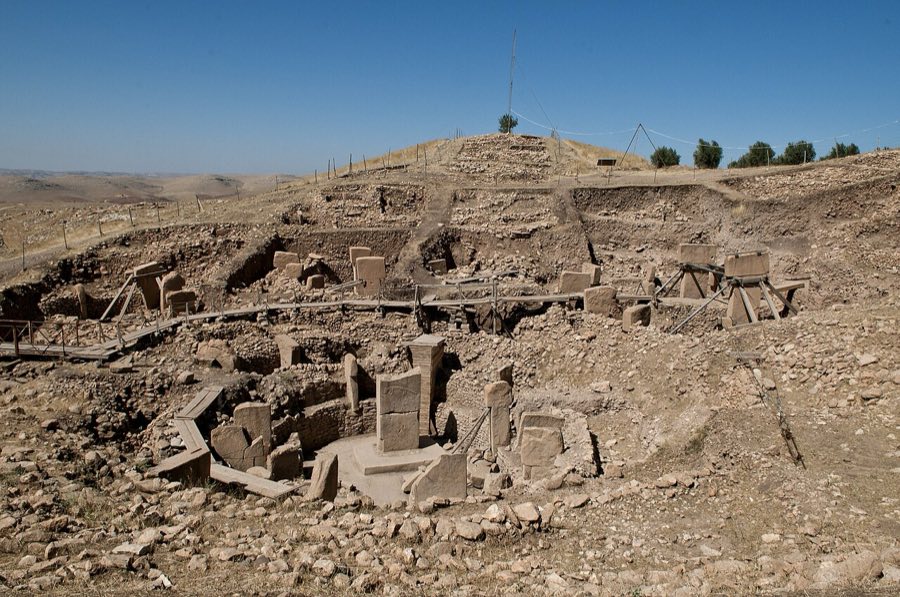
Göbekli Tepe is the Pre-Pottery Neolithic hilltop sanctuary near Şanlıurfa, built by hunter-gatherers from about 9500 BCE, with monumental carved pillars predating agriculture and pottery. It has transformed views of the origins of religion and settlement.
| Country | Turkey |
|---|---|
| State / province | Şanlıurfa |
| Dates | 9500–8000 BCE |
| Status | Archaeological site and UNESCO World Heritage Site |
| Managed by | Turkish Ministry of Culture and Tourism with the German Archaeological Institute |
| Access | Open to the public with a canopy over the enclosures and a visitor centre |
| Coordinates | 37.223, 38.922 (public site) |
What was found
Excavations exposed circular enclosures of T-shaped limestone pillars carved with foxes, boars, snakes, birds and scorpions, along with flint tools, stone vessels, grinding stones and animal bones from feasting. Pillars and finds are displayed in the Şanlıurfa Archaeology Museum.
Rules
Nothing may be collected, dug, moved or removed at Göbekli Tepe; it is a protected archaeological site managed by Turkish Ministry of Culture and Tourism with the German Archaeological Institute, and taking artifacts, stones or samples is an offence. Turkish law vests all antiquities in the state, and removal or export is a crime. This article is for study and context only and is not a collecting locality.
Elsewhere
Cite this article
Stratum Study. "Göbekli Tepe" (Site). Stratum Study pack 2026.09, as of 2026-09-21. https://stratum.black/study/sites/gobekli-tepe. Accessed 2026-09-21.
@misc{stratum-gobekli-tepe,
  title        = {Göbekli Tepe},
  author       = {{Stratum Study}},
  howpublished = {\url{https://stratum.black/study/sites/gobekli-tepe}},
  year         = {2026},
  note         = {Site article, Stratum Study pack 2026.09, as of 2026-09-21; sources: stratum, wikidata, commons. Accessed 2026-09-21.}
}
Citations carry the pack version and the article's as-of date so they resolve to the same text later. The facts themselves belong to the sources listed below; cite those for the science.