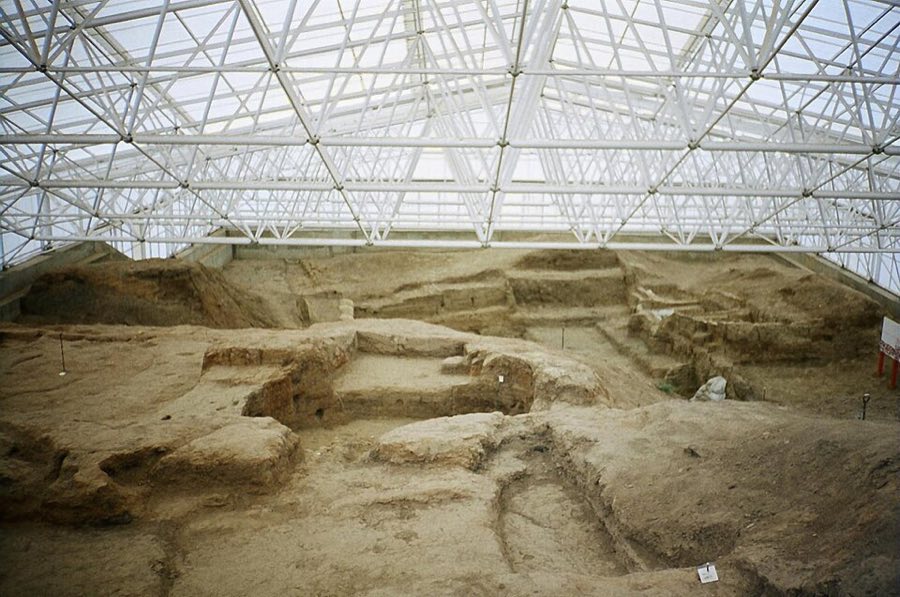

Site · Turkey
Çatalhöyük
7400–5600 BCE
Çatalhöyük is the large Neolithic town on the Konya plain, occupied from about 7400 to 5600 BCE by up to eight thousand people in houses entered from the roof, with shrines, figurines and burials under floors. It is a key site for early farming and art.
| Country | Turkey |
|---|---|
| State / province | Konya |
| Dates | 7400–5600 BCE |
| Status | Archaeological site and UNESCO World Heritage Site |
| Managed by | Turkish Ministry of Culture and Tourism |
| Access | Open to the public with shelters over the excavated areas |
| Coordinates | 37.667, 32.828 (public site) |
What was found
Excavations by Mellaart and Hodder recovered wall paintings and bucrania, the 'seated woman' figurine, obsidian mirrors and tools, burials beneath house floors, plastered skulls, pottery and textiles. Finds are in the Museum of Anatolian Civilizations in Ankara and the Konya museum.
Rules
Nothing may be collected, dug, moved or removed at Çatalhöyük; it is a protected archaeological site managed by Turkish Ministry of Culture and Tourism, and taking artifacts, stones or samples is an offence. Turkish law vests all antiquities in the state, and removal or export is a crime. This article is for study and context only and is not a collecting locality.
Elsewhere
Cite this article
Stratum Study. "Çatalhöyük" (Site). Stratum Study pack 2026.09, as of 2026-09-21. https://stratum.black/study/sites/catalhoyuk. Accessed 2026-09-21.
@misc{stratum-catalhoyuk,
  title        = {Çatalhöyük},
  author       = {{Stratum Study}},
  howpublished = {\url{https://stratum.black/study/sites/catalhoyuk}},
  year         = {2026},
  note         = {Site article, Stratum Study pack 2026.09, as of 2026-09-21; sources: stratum, wikidata, commons. Accessed 2026-09-21.}
}
Citations carry the pack version and the article's as-of date so they resolve to the same text later. The facts themselves belong to the sources listed below; cite those for the science.