
Variety · Beryl group
Aquamarine
Be3Al2(Si6O18)
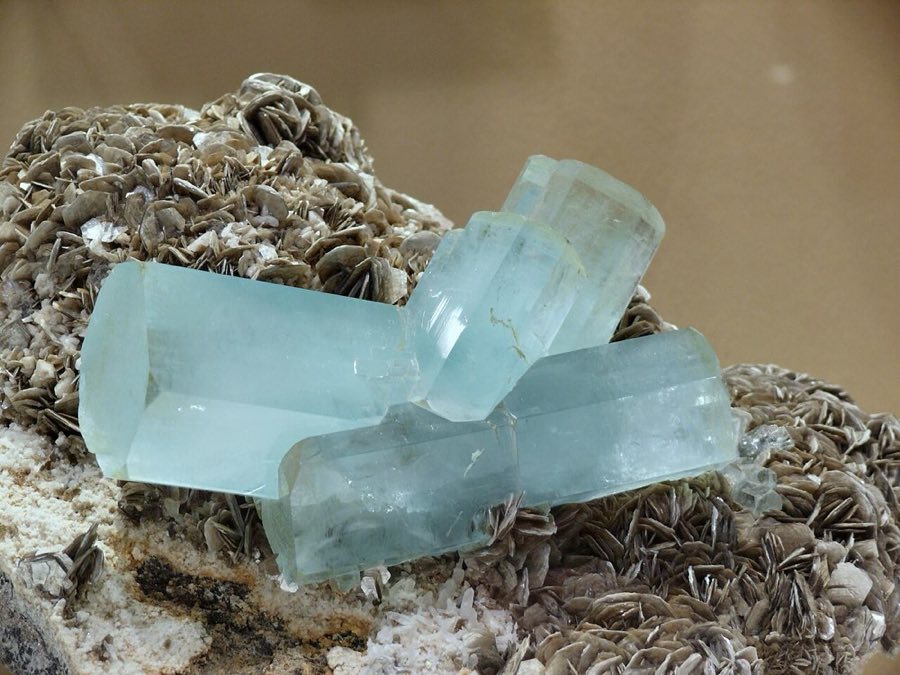
Aquamarine is blue to blue-green beryl from Pakistan (Shigar Valley, on muscovite), Brazil, Nigeria, Namibia's Erongo and Vietnam. Transparent, sharp, gem-quality prisms on matrix are the premium specimens; Erongo aquamarine with schorl and feldspar is the affordable classic. Most cut aquamarine is heated to remove green; specimens are usually untreated.
| Formula | Be3Al2(Si6O18) |
|---|---|
| IMA status | variety |
| Crystal system | Hexagonal |
| Mohs hardness | 7.5–8 |
| Group | Beryl group |
| Type locality | None (variety) |
Fakes and treatments
Greenish beryl is heated to pure blue for gems; some 'aquamarine' crystals are glass or synthetic spinel.
Elsewhere
Cite this article
Stratum Study. "Aquamarine" (Mineral). Stratum Study pack 2026.09, as of 2026-09-19. https://stratum.black/study/minerals/aquamarine. Accessed 2026-09-20.
@misc{stratum-aquamarine,
  title        = {Aquamarine},
  author       = {{Stratum Study}},
  howpublished = {\url{https://stratum.black/study/minerals/aquamarine}},
  year         = {2026},
  note         = {Mineral article, Stratum Study pack 2026.09, as of 2026-09-19; sources: stratum, wikidata, commons. Accessed 2026-09-20.}
}
Citations carry the pack version and the article's as-of date so they resolve to the same text later. The facts themselves belong to the sources listed below; cite those for the science.