
Material · lithic
Quartzite
North America — Eastern Woodlands, North America — Southeast, North America — Great Plains, Europe — Western & Central
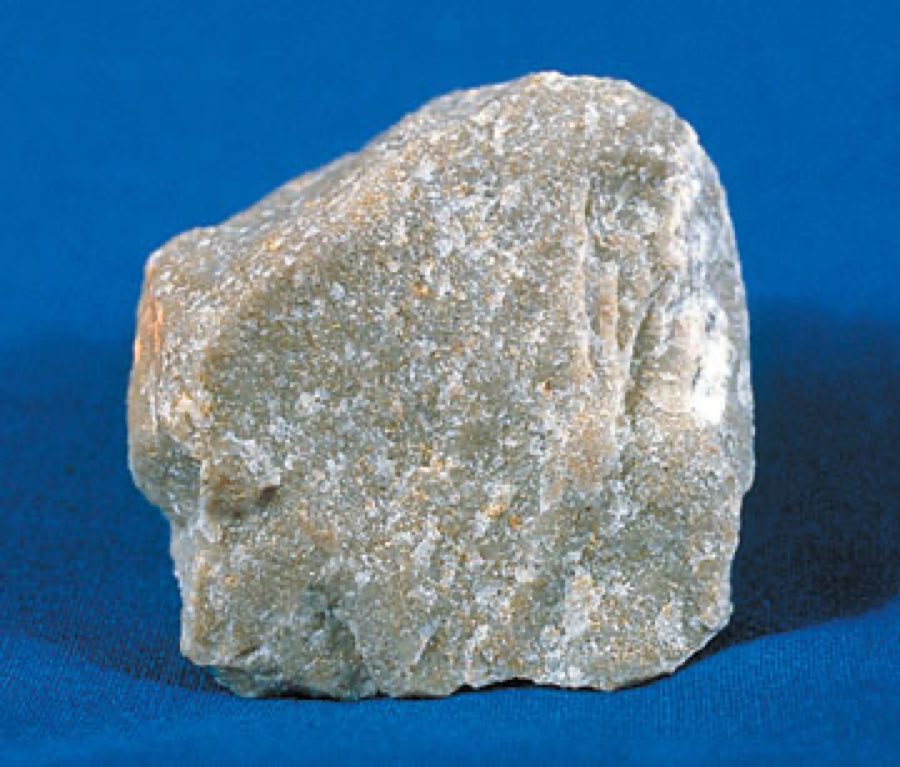
Quartzite is metamorphosed or silica-cemented sandstone, a coarse but tough toolstone used for large Late Archaic points like Savannah River in the Southeast, for Plains tools, and for Palaeolithic handaxes and choppers in Europe, Africa and Asia. It does not flake as finely as chert. Big quartzite broadspears are typical Atlantic Coast finds.
| Kind | lithic |
|---|---|
| Regions | North America — Eastern Woodlands, North America — Southeast, North America — Great Plains, Europe — Western & Central |
Sources
Quartzite occurs in metamorphic belts and Precambrian and Palaeozoic sandstones across the Appalachians, the Canadian Shield, the Rockies and Europe; cobbles are abundant in rivers. Large cobbles were split and flaked on the spot rather than carried far.
Identification
Quartzite is granular, sugary in texture, grey, white, tan, pink or purple, with a dull lustre and a rough fracture that shows individual grains. It does not patinate like chert. Some varieties such as Hixton are finer and sparkle.
Substitutes and fakes
Rarely faked because it is unattractive and hard to work, but reproductions of Savannah River points exist. The absence of patina on quartzite makes age hard to judge and edge wear is the guide.
Elsewhere
- Wikidata: Q237883
- Wikipedia: quartzite
Cite this article
Stratum Study. "Quartzite" (Material). Stratum Study pack 2026.09, as of 2026-09-21. https://stratum.black/study/materials/quartzite. Accessed 2026-09-21.
@misc{stratum-quartzite,
  title        = {Quartzite},
  author       = {{Stratum Study}},
  howpublished = {\url{https://stratum.black/study/materials/quartzite}},
  year         = {2026},
  note         = {Material article, Stratum Study pack 2026.09, as of 2026-09-21; sources: stratum, wikidata, commons. Accessed 2026-09-21.}
}
Citations carry the pack version and the article's as-of date so they resolve to the same text later. The facts themselves belong to the sources listed below; cite those for the science.