
Group · Cretaceous
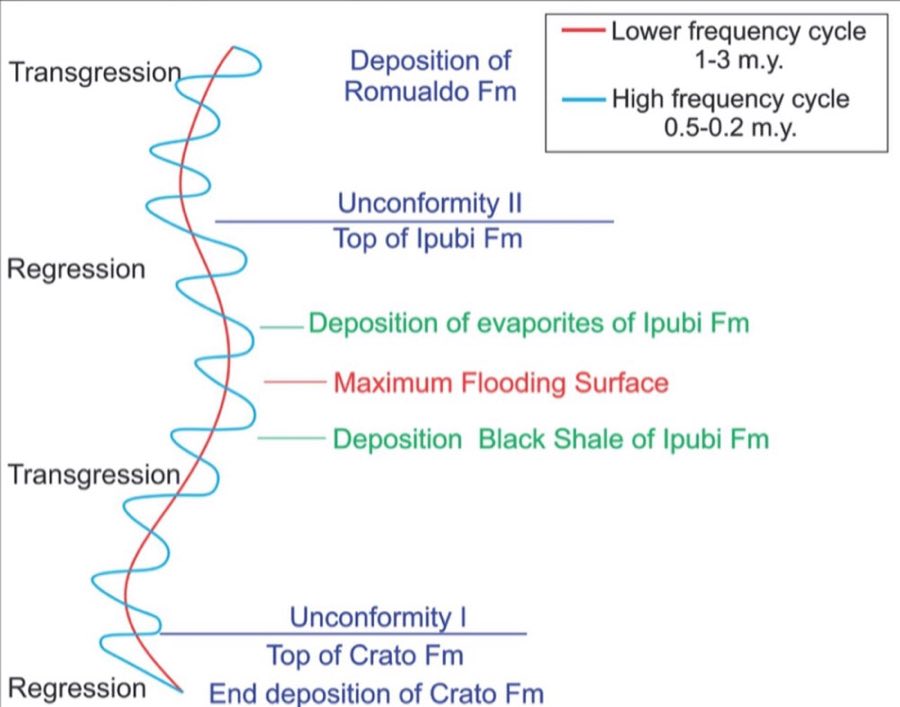
Santana Group (Crato and Romualdo formations)
Early Cretaceous unit, Ceará · Pernambuco · Piauí
The Santana Group of the Araripe Basin in northeastern Brazil produced the famous three-dimensional fish in nodules (Vinctifer, Rhacolepis, Cladocyclus), Crato insects and plants, and crested pterosaurs such as Tupandactylus. It is included so that collectors understand the legal position: Brazil bans fossil export, and the material that flooded the market in the 1980s–2000s is now toxic to museums and increasingly to auction houses. Stratum flags Brazilian provenance for the compliance gate.
| Country | Brazil |
|---|---|
| Region | Ceará, Pernambuco, Piauí |
| Age | Aptian, Early Cretaceous |
| Age range | ~115–110 Ma |
| Group | Santana Group |
| Macrostrat rank | Fm· Macrostrat |
| Macrostrat age | 115–108 Ma· Macrostrat |
| Lithology | gypsum, marl, shale, mudstone· Macrostrat |
| Environment | open shallow subtidal, perireef, lagoonal/restricted shallow subtidal, marine· Macrostrat |
| Macrostrat columns | 3 column(s) sampled from 8 unit(s)· Macrostrat |
| Members (Macrostrat) | Crato, Ipubi, Romualdo· Macrostrat |
| PBDB collections | 130 collections, 1232 occurrences· Paleobiology Database |
Collecting and legality
Brazil has treated fossils as state property and banned their commercial export since 1942 (Decree-Law 4146); since the 1990s prosecutions and repatriations of Santana pterosaurs, insects and fish have become routine, and reputable dealers no longer handle new Brazilian material. Old pre-1990 collection pieces exist but need documented history, and buyers should expect institutions to refuse them.
Lithology and setting
The Crato Formation is a laminated lacustrine limestone; the overlying Romualdo Formation preserves fish and pterosaurs three-dimensionally inside calcareous concretions.
Commonly recorded taxa (PBDB)
Genera most often recorded from this unit in the Paleobiology Database (first 200 occurrences): Anhanguera (10), Pterodactyloidea (7), Hallex (5), Locustopsis (5), Mesolocustopsis (5), Protodelphax (5), Tupuxuara (5), Cordulagomphus (4), Gomphaeschnaoides (4), Ancorale (3), Carpopodus (3), Cratomacer (3), Euarchistigma (3), Leptophlebiidae (3), Patulopes (3).
Source: Paleobiology Database
Elsewhere
Cite this article
Stratum Study. "Santana Group (Crato and Romualdo formations)" (Formation). Stratum Study pack 2026.09, as of 2026-09-19. https://stratum.black/study/formations/santana-group-crato-and-romualdo-formations. Accessed 2026-09-20.
@misc{stratum-santana-group-crato-and-romualdo-formati,
  title        = {Santana Group (Crato and Romualdo formations)},
  author       = {{Stratum Study}},
  howpublished = {\url{https://stratum.black/study/formations/santana-group-crato-and-romualdo-formations}},
  year         = {2026},
  note         = {Formation article, Stratum Study pack 2026.09, as of 2026-09-19; sources: stratum, macrostrat, pbdb, commons. Accessed 2026-09-20.}
}
Citations carry the pack version and the article's as-of date so they resolve to the same text later. The facts themselves belong to the sources listed below; cite those for the science.