
Formation · Jurassic
Oxford Clay Formation
Middle Jurassic unit, Cambridgeshire · Bedfordshire · Oxfordshire · Wiltshire
The Oxford Clay of the English Midlands and Dorset is the Middle–Late Jurassic marine clay of the Peterborough brick pits, source of the marine reptiles Liopleurodon, Cryptoclidus and Ophthalmosaurus, the giant fish Leedsichthys, and the ubiquitous crushed ammonite Kosmoceras. Collectors hold pyritised Kosmoceras, belemnites and reptile teeth; new material is scarce since the pits closed. Kosmoceras with its shell preserved as pyrite is prone to decay, so keep it dry.
| Country | United Kingdom |
|---|---|
| Region | Cambridgeshire, Bedfordshire, Oxfordshire, Wiltshire, Dorset |
| Age | Callovian, Middle Jurassic |
| Age range | ~165–157 Ma |
| Group | Ancholme Group |
| Macrostrat rank | Fm· Macrostrat |
| Macrostrat age | 165–155 Ma· Macrostrat |
| PBDB collections | 94 collections, 370 occurrences· Paleobiology Database |
Collecting and legality
The classic Peterborough brick pits are largely closed or restored; the few working pits require company permission and insurance. Beach exposures at Weymouth follow the Jurassic Coast code. Old brick-pit collections (the Leeds Collection era) are the source of most reptile material in trade.
Lithology and setting
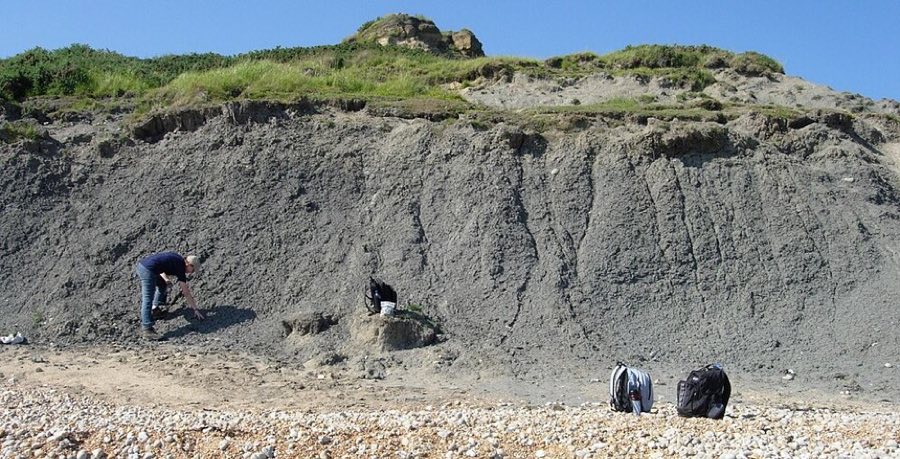
Grey-brown fissile mudstone with pyritised and crushed ammonites, laid down in a moderately deep Callovian–Oxfordian sea.
Commonly recorded taxa (PBDB)
Genera most often recorded from this unit in the Paleobiology Database (first 200 occurrences): Mollusca (13), Procerithium (13), Meleagrinella (12), Palaeonucula (11), Mesosaccella (10), Bositra (9), Corbulomima (8), Thracia (6), Anomalodesmatan (5), Dicroloma (5), Gryphaea (5), Grammatodon (4), Pinna (4), Cryptoclidus (3), Nicaniella (3).
Source: Paleobiology Database
Elsewhere
- Macrostrat: 98520
- macrostratConcept: 31429
- PBDB: strata:Oxford Clay
- Wikidata: Q7115292
- Macrostrat stratigraphic name
- PBDB occurrences for this unit
- Wikipedia: Oxford Clay Formation
- Mindat: Oxford Clay Formation
Cite this article
Stratum Study. "Oxford Clay Formation" (Formation). Stratum Study pack 2026.09, as of 2026-09-19. https://stratum.black/study/formations/oxford-clay-formation. Accessed 2026-09-20.
@misc{stratum-oxford-clay-formation,
  title        = {Oxford Clay Formation},
  author       = {{Stratum Study}},
  howpublished = {\url{https://stratum.black/study/formations/oxford-clay-formation}},
  year         = {2026},
  note         = {Formation article, Stratum Study pack 2026.09, as of 2026-09-19; sources: stratum, macrostrat, pbdb, wikidata, commons. Accessed 2026-09-20.}
}
Citations carry the pack version and the article's as-of date so they resolve to the same text later. The facts themselves belong to the sources listed below; cite those for the science.