
Culture · Paleoindian
Western Stemmed Tradition
12500–7000 BCE, North America — Great Basin & Plateau
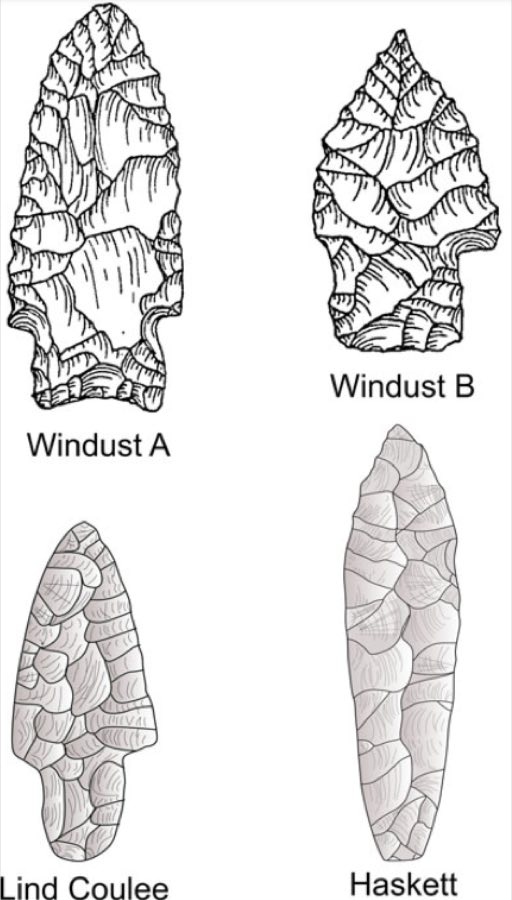
The Western Stemmed Tradition is the Paleoindian and earliest Archaic technology of the Great Basin, the Columbia Plateau and the far West, running from about 12,500 to 7,000 BCE and, at Paisley Caves and Cooper's Ferry, as early as or earlier than Clovis. Its makers used large stemmed and shouldered points on lakeshores and river terraces rather than the fluted points of the east. Collectors know it through Windust, Lake Mojave, Silver Lake and later Cascade points, most in obsidian and basalt from surface contexts on old lake beds.
| Dates | 12500–7000 BCE |
|---|---|
| Period | Paleoindian |
| Region | North America — Great Basin & Plateau |
| Areas | Great Basin, Columbia Plateau, Snake River Plain, Mojave Desert |
| Typical objects | Projectile point, Scraper, Biface |
| Typical materials | Obsidian, Chert, Basalt |
Identification
Stemmed rather than fluted: long contracting or straight stems with ground edges, weak shoulders, and heavy collateral flaking; obsidian and basalt dominate. Crescents (chipped stone lunates) accompany the points on lake margins and are a strong marker of the tradition. Cascade points are leaf-shaped and unstemmed.
Legality
Nearly all Western Stemmed finds come from Bureau of Land Management, Forest Service or tribal land, where removal is a federal offence under ARPA and the arrowhead exemption does not make surface finds legal to keep or sell; a point is saleable only from private land with permission or from a documented pre-1979 collection. Nevada, Oregon, Utah and California state land carries the same prohibition under state antiquities codes.
Reproductions and fakes
Obsidian is the easiest stone to knap and Western Stemmed forms are widely reproduced; fakes lack the hydration rind and the dulled, sandblasted surface of a genuine lake-bed find and show fresh conchoidal scars. Ground stem edges are a good sign but can be faked.
Elsewhere
Cite this article
Stratum Study. "Western Stemmed Tradition" (Culture). Stratum Study pack 2026.09, as of 2026-09-21. https://stratum.black/study/cultures/western-stemmed-tradition. Accessed 2026-09-21.
@misc{stratum-western-stemmed-tradition,
  title        = {Western Stemmed Tradition},
  author       = {{Stratum Study}},
  howpublished = {\url{https://stratum.black/study/cultures/western-stemmed-tradition}},
  year         = {2026},
  note         = {Culture article, Stratum Study pack 2026.09, as of 2026-09-21; sources: stratum, wikidata, commons. Accessed 2026-09-21.}
}
Citations carry the pack version and the article's as-of date so they resolve to the same text later. The facts themselves belong to the sources listed below; cite those for the science.