Culture · Iron Age
Luristan
1300–650 BCE, Near East & Mesopotamia
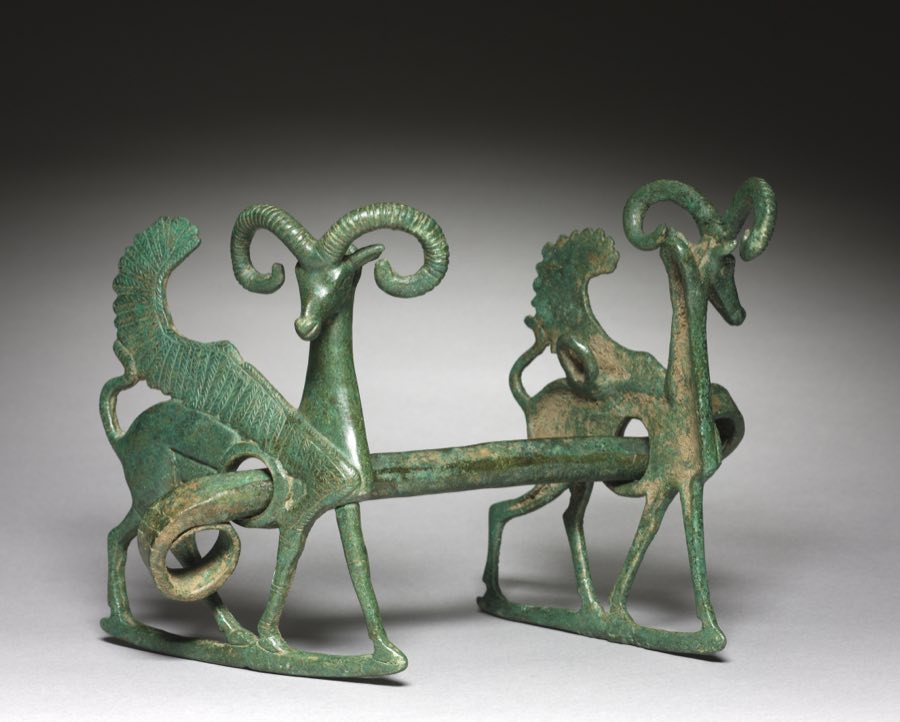
'Luristan bronzes' are the highly stylised bronze weapons, horse gear and ornaments made by pastoral peoples of the central Zagros in western Iran between about 1300 and 650 BCE and buried in stone-lined cist graves. They came onto the market in floods after 1928 when villagers began looting the cemeteries, so the great majority have no findspot; the Belgian excavations in Pusht-i Kuh from 1965 provided the only reliable sequence. The repertoire includes horse bits with fantastic-animal cheekpieces, 'master of animals' standards, spiked axes, daggers with inscribed blades, pins with decorated heads and openwork finials. They remain a staple of the antiquities trade in Europe and the United States.
| Dates | 1300–650 BCE |
|---|---|
| Period | Iron Age |
| Region | Near East & Mesopotamia |
| Areas | Lorestan province, western Iran (Zagros Mountains), Pusht-i Kuh, Pish-i Kuh |
| Typical objects | Axe head, Dagger, Sword, Spearhead, Bracelet, Pendant, Figurine, Vessel |
| Typical materials | Bronze, Iron, Terracotta |
Identification
Luristan style stretches animals into elongated, symmetrical, openwork compositions, and the horse bit with a cast figured cheekpiece is unique to it; Elamite and Mesopotamian bronzes are more naturalistic. Iron swords with bronze hilts of the 'mask' type and spike-butted axes belong to the Iron Age I–II phases; the Bronze Age 'Luristan' daggers and axes of the second millennium are plainer.
Legality
Iran's National Heritage Protection Act of 1930 and the 1979 penal provisions make antiquities state property and forbid export, and US sanctions administered by OFAC prohibit the import of Iranian-origin goods, including antiquities, except for items already outside Iran before the sanctions. There is no CPIA designated list for Iran, but customs enforcement treats undocumented Iranian material as suspect. Lawful pieces are those with documented presence in Western collections before 1979.
Reproductions and fakes
Luristan bronzes have been faked since the 1930s and modern casts, including pastiches assembling ancient fragments, are abundant; genuine bronzes show a hard, layered green and red patina with earthy deposits and casting cores, while fakes have a soft, even, sometimes painted patina and a crisp uniform surface. Inscribed daggers are frequently 'improved' with modern cuneiform.
Cite this article
Stratum Study. "Luristan" (Culture). Stratum Study pack 2026.09, as of 2026-09-21. https://stratum.black/study/cultures/luristan. Accessed 2026-09-21.
@misc{stratum-luristan,
  title        = {Luristan},
  author       = {{Stratum Study}},
  howpublished = {\url{https://stratum.black/study/cultures/luristan}},
  year         = {2026},
  note         = {Culture article, Stratum Study pack 2026.09, as of 2026-09-21; sources: stratum, cleveland. Accessed 2026-09-21.}
}
Citations carry the pack version and the article's as-of date so they resolve to the same text later. The facts themselves belong to the sources listed below; cite those for the science.