
Culture · Paleoindian
Dalton
8500–7900 BCE, North America — Southeast
Dalton is the transitional Paleoindian to Early Archaic tradition of the central Mississippi Valley and Southeast, dated to around 8,500 to 7,900 BCE. It is known from cemeteries such as Sloan in Arkansas as well as camps and base settlements, and marks a shift from big-game hunting toward deer, small game and plant foods. Collectors hold Dalton points and knives in every stage of resharpening, plus the chipped adzes that are the earliest woodworking tools in the region.
| Dates | 8500–7900 BCE |
|---|---|
| Period | Paleoindian |
| Region | North America — Southeast |
| Areas | Mississippi Valley, Ozarks, Southeast |
| Typical objects | Projectile point, Adze, Scraper |
| Typical materials | Burlington chert, Chert, Novaculite |
Identification
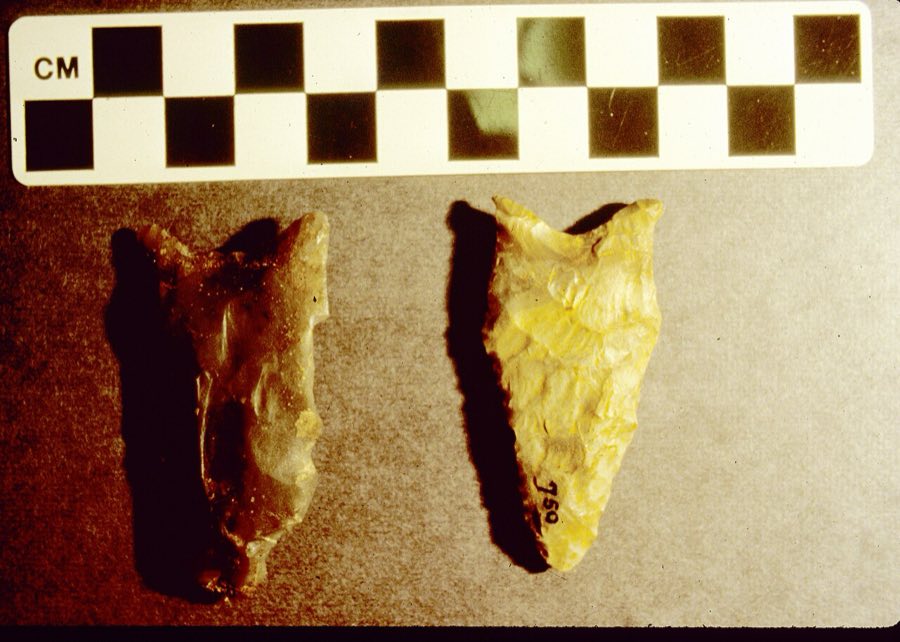
Dalton points have a deeply concave, ground base with basal thinning and a blade that becomes serrated and bevelled as it was resharpened, often ending as a drill or a stubby knife. The Dalton adze is a thick, plano-convex chipped tool with a polished bit. Burlington chert from Missouri and novaculite from Arkansas are the most common materials.
Legality
In the United States, prehistoric artifacts may be collected and sold only when they come from private land with the landowner's permission; removal from federal, tribal or most state land is prohibited under ARPA and state statutes. Funerary objects, human remains and sacred items are covered by NAGPRA and are not legitimately traded, and Canadian provinces treat archaeological finds as Crown or provincial property. Dalton cemeteries are burial contexts, so any piece described as coming from a grave or cache should be avoided.
Reproductions and fakes
Dalton points are faked in Missouri and Arkansas chert because large, serrated examples bring strong prices. Genuine examples nearly always show heavy resharpening, basal grinding and an asymmetry that fakes lack, and the serrations on fakes are often too uniform. Burlington chert heat-treated in a modern kiln has a glassy pink lustre that differs from the natural stone.
Elsewhere
- Wikidata: Q3699292
- Wikipedia: Dalton Tradition
Cite this article
Stratum Study. "Dalton" (Culture). Stratum Study pack 2026.09, as of 2026-09-21. https://stratum.black/study/cultures/dalton. Accessed 2026-09-21.
@misc{stratum-dalton,
  title        = {Dalton},
  author       = {{Stratum Study}},
  howpublished = {\url{https://stratum.black/study/cultures/dalton}},
  year         = {2026},
  note         = {Culture article, Stratum Study pack 2026.09, as of 2026-09-21; sources: stratum, wikidata, commons. Accessed 2026-09-21.}
}
Citations carry the pack version and the article's as-of date so they resolve to the same text later. The facts themselves belong to the sources listed below; cite those for the science.