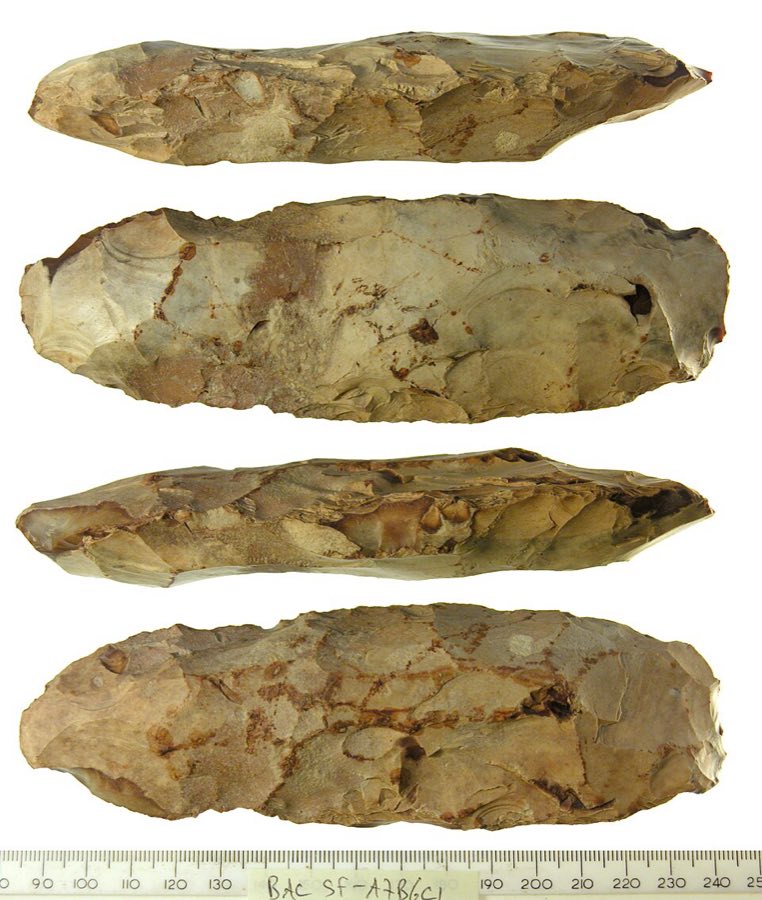

Axe head · Mesolithic
Tranchet axe
9000–4000 BCE, Ertebølle
Tranchet axes are the heavy woodworking tool of the north European Mesolithic, from the Maglemosian through Ertebølle in Denmark and southern Sweden and in the British Mesolithic of the Thames valley and Kent. They are 80–200 mm long, made on cores or thick flakes, and were resharpened by repeating the tranchet blow, so many are short and stubby. Collectors hold them as the earliest distinct axe form in northern Europe, well before polished Neolithic axes.
| Object | Axe head |
|---|---|
| Dates | 9000–4000 BCE |
| Period | Mesolithic |
| Cultures | Ertebølle |
| Regions | Europe — Northern & British Isles, Europe — Western & Central |
Diagnostic traits
A chunky flaked flint axe or adze whose working edge was made by a single transverse blow that removed a flake across the tip, leaving a sharp unpolished chisel edge.
Identification
The transverse tranchet scar at the edge is the diagnostic feature; a polished stone axe has a ground edge and a Neolithic rough-out lacks the single cross-cutting edge flake. Confusion with a Neolithic axe rough-out is common, but rough-outs are symmetrical preforms with no finished edge and no use damage. The British Thames pick is a longer, narrower relative with a pointed rather than chisel tip.
Reproductions and fakes
Modern knappers produce tranchet axes easily from fresh flint; look for a uniform white or blue-grey patina over every scar, edge damage from use, and river staining on Thames examples. A bright, glassy surface with no differential patina between scars is a warning sign.
Elsewhere
- Wikidata: Q2232541
- Wikipedia: tranchet axe
Cite this article
Stratum Strata. "Tranchet axe" (Artifact type). Stratum Strata pack 2026.09, as of 2026-09-21. https://stratum.black/strata/types/tranchet-axe. Accessed 2026-09-21.
@misc{stratum-tranchet-axe,
  title        = {Tranchet axe},
  author       = {{Stratum Strata}},
  howpublished = {\url{https://stratum.black/strata/types/tranchet-axe}},
  year         = {2026},
  note         = {Artifact type article, Stratum Strata pack 2026.09, as of 2026-09-21; sources: stratum, wikidata, commons. Accessed 2026-09-21.}
}
Citations carry the pack version and the article's as-of date so they resolve to the same text later. The facts themselves belong to the sources listed below; cite those for the science.