
Culture · Mesolithic
Ertebølle
5400–3950 BCE, Europe — Northern & British Isles
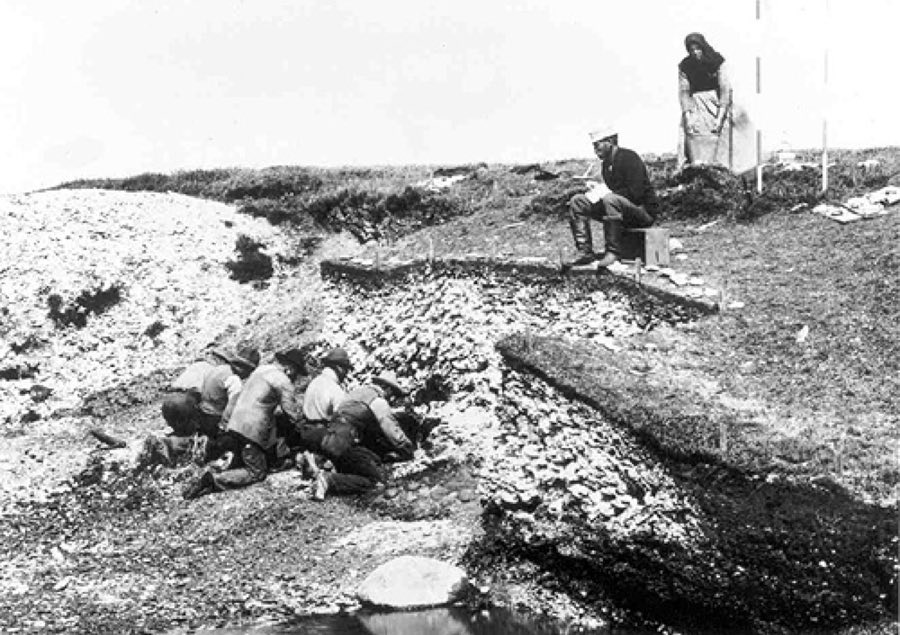
Ertebølle is the last hunter-gatherer culture of southern Scandinavia, named after a shell midden in Jutland and dated to about 5400–3950 BCE. Its people lived on coasts and fjords, fishing with weirs, hunting seals and deer and building up huge oyster and cockle middens. Late in the period they adopted pottery, pointed-based cooking pots and oval lamps, from farming neighbours to the south. Flake and core axes, transverse arrowheads, bone points and antler axes are the diagnostic tools, and the culture ends with the arrival of Funnelbeaker farming.
| Dates | 5400–3950 BCE |
|---|---|
| Period | Mesolithic |
| Region | Europe — Northern & British Isles |
| Areas | Denmark, Scania, Schleswig-Holstein, Northern Germany |
| Typical objects | Axe head, Blade, Core, Harpoon head, Vessel |
| Typical materials | Flint, Bone and antler, Terracotta |
Identification
Ertebølle flintwork is dominated by transverse (chisel-ended) arrowheads and flake axes with a tranchet edge; the earlier Maglemosian and Kongemose have microliths and rhombic points instead. Pointed-based pots with thick walls and simple impressed rims are unlike anything in the Neolithic. Antler T-shaped axes and decorated bone objects are characteristic.
Legality
Denmark's Museum Act (Museumsloven) declares finds of danefæ, which include worked flint and bone from Mesolithic sites of special value, to be state property that must be handed to the National Museum, and export of cultural objects needs a permit under the Act on Protection of Cultural Assets. Sweden's Heritage Conservation Act and Germany's state monument laws impose similar reporting and permit rules; there is no CPIA designated list for these countries but unlawful export is enforced through EU regulation.
Reproductions and fakes
Modern knappers produce flake and core axes from Danish flint easily; genuine pieces have a uniform patina, edge wear and sometimes shell-midden residue. Bone points are rarely faked but are often mis-dated.
Elsewhere
- Wikidata: Q1362485
- Wikipedia: Ertebølle culture
Cite this article
Stratum Strata. "Ertebølle" (Culture). Stratum Strata pack 2026.09, as of 2026-09-21. https://stratum.black/strata/cultures/ertebolle. Accessed 2026-09-21.
@misc{stratum-ertebolle,
  title        = {Ertebølle},
  author       = {{Stratum Strata}},
  howpublished = {\url{https://stratum.black/strata/cultures/ertebolle}},
  year         = {2026},
  note         = {Culture article, Stratum Strata pack 2026.09, as of 2026-09-21; sources: stratum, wikidata, commons. Accessed 2026-09-21.}
}
Citations carry the pack version and the article's as-of date so they resolve to the same text later. The facts themselves belong to the sources listed below; cite those for the science.