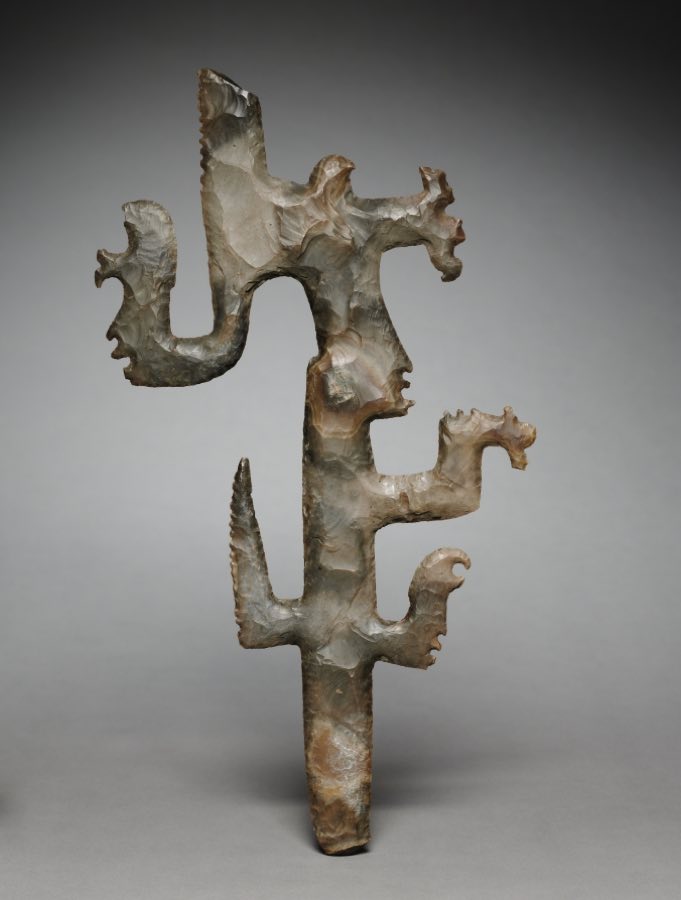
Biface · Late Classic
Maya eccentric flint
250–900 CE, Maya
Eccentric flints were placed in caches beneath stelae and temple floors at Classic Maya cities such as Copán, Quiriguá, Tikal and the Belize sites, usually in sets of nine or more. The Belize and Petén cherts allowed large, thin pieces up to 400 mm long showing profiles of kings and gods; obsidian eccentrics are smaller. Nearly all on the market came from looting of cache deposits, and Belize, Guatemala, Honduras and Mexico prohibit export.
| Object | Biface |
|---|---|
| Dates | 250–900 CE |
| Period | Late Classic |
| Cultures | Maya |
| Regions | Mesoamerica |
Diagnostic traits
A bifacially flaked chert or obsidian object of deliberately non-utilitarian form, such as a human profile, scorpion, crescent or notched lozenge, often with multiple projecting heads.
Identification
An eccentric is not a tool: edges are unworked for cutting, symmetry is thematic rather than functional, and the flaking is fine and invasive. Large Maya bifaces and 'macroblades' are utilitarian and plain. Modern eccentrics made in Belize and Guatemala for tourists are the main confusion.
Reproductions and fakes
Modern knappers in Belize and Mexico produce eccentrics from the same honey-coloured chert; genuine pieces have a patina and surface sheen from burial, sometimes with cinnabar or lime residue in the flake scars, while copies are bright and uniformly fresh. Any eccentric flint offered without a pre-1970s provenance should be treated as looted or modern.
Cite this article
Stratum Strata. "Maya eccentric flint" (Artifact type). Stratum Strata pack 2026.09, as of 2026-09-21. https://stratum.black/strata/types/maya-eccentric-flint. Accessed 2026-09-21.
@misc{stratum-maya-eccentric-flint,
  title        = {Maya eccentric flint},
  author       = {{Stratum Strata}},
  howpublished = {\url{https://stratum.black/strata/types/maya-eccentric-flint}},
  year         = {2026},
  note         = {Artifact type article, Stratum Strata pack 2026.09, as of 2026-09-21; sources: stratum, cleveland. Accessed 2026-09-21.}
}
Citations carry the pack version and the article's as-of date so they resolve to the same text later. The facts themselves belong to the sources listed below; cite those for the science.