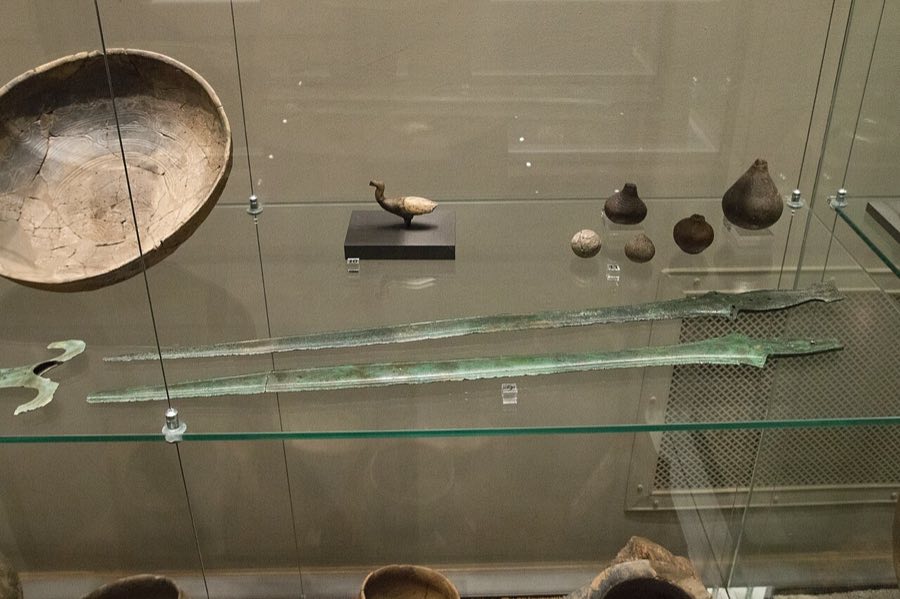

Sword · Hallstatt
Hallstatt sword
800–600 BCE, Hallstatt
The Hallstatt C sword (about 800–600 BCE) is the weapon of the early Iron Age chiefs buried under wagon graves from Bohemia to Burgundy, and the first common iron sword in Europe. Gündlingen swords are bronze and shorter, while the Mindelheim type is iron and can exceed 1 m; both share the broad blade and chape. Complete examples are museum objects; the market sees fragments, chapes and bronze examples from old collections.
| Object | Sword |
|---|---|
| Dates | 800–600 BCE |
| Period | Hallstatt |
| Cultures | Hallstatt |
| Regions | Europe — Western & Central |
Diagnostic traits
A long slashing sword of bronze or iron with a broad leaf-shaped blade, a flat tang for a hilt of organic plates and often a cap-shaped or 'Mexican hat' pommel.
Identification
Compared with the Late Bronze Age leaf-shaped sword, the Hallstatt sword is longer, wider at the blade centre and has a distinct winged or boat-shaped chape at the scabbard tip. The later Hallstatt D dagger and the La Tène sword are shorter, with a narrower parallel-sided blade and iron scabbard. A Naue II or Ewart Park sword has a flanged hilt cast in one with the blade rather than a simple tang.
Reproductions and fakes
Corroded iron is rarely faked but is frequently over-cleaned and reassembled; bronze Hallstatt swords are copied in modern castings with artificial patina that flakes away at the edges. A genuine iron blade shows laminated corrosion and remains of the mineralised organic hilt plates.
Cite this article
Stratum Strata. "Hallstatt sword" (Artifact type). Stratum Strata pack 2026.09, as of 2026-09-21. https://stratum.black/strata/types/hallstatt-sword. Accessed 2026-09-21.
@misc{stratum-hallstatt-sword,
  title        = {Hallstatt sword},
  author       = {{Stratum Strata}},
  howpublished = {\url{https://stratum.black/strata/types/hallstatt-sword}},
  year         = {2026},
  note         = {Artifact type article, Stratum Strata pack 2026.09, as of 2026-09-21; sources: stratum, commons. Accessed 2026-09-21.}
}
Citations carry the pack version and the article's as-of date so they resolve to the same text later. The facts themselves belong to the sources listed below; cite those for the science.