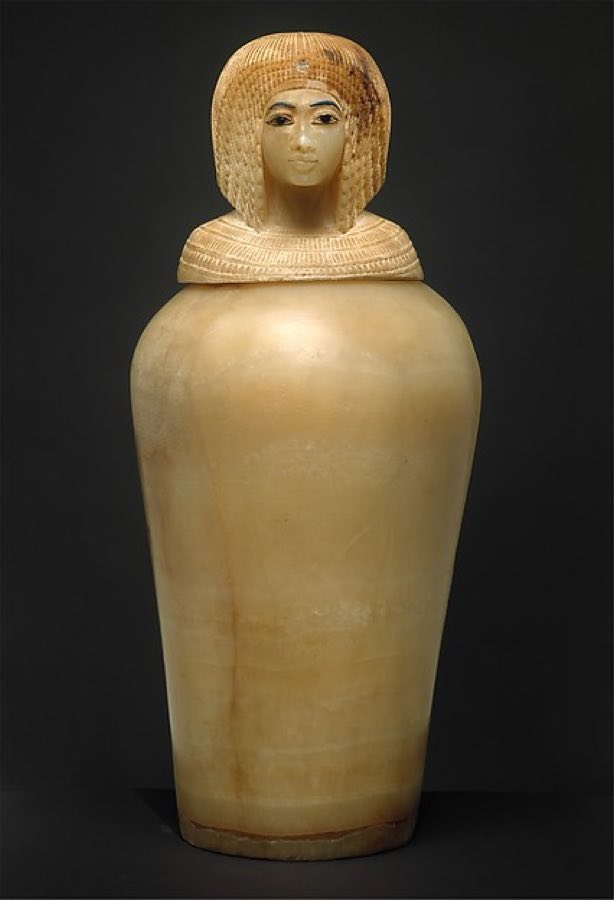
Canopic jar · New Kingdom
Canopic jar
2500–30 BCE, Dynastic Egypt
The canopic jar is the lidded vessel that held the embalmed organs of the deceased in Egypt from the Old Kingdom to the Ptolemaic period, about 2,500 to 30 BCE, in sets of four. From the New Kingdom the lids depict the four Sons of Horus with human, baboon, jackal and falcon heads. Jars are limestone, alabaster, pottery or wood.
| Object | Canopic jar |
|---|---|
| Dates | 2500–30 BCE |
| Period | New Kingdom |
| Cultures | Dynastic Egypt |
| Regions | Egypt & Nile Valley |
Diagnostic traits
Lidded stone or pottery jar for embalmed organs; from the New Kingdom the lids depict the four Sons of Horus.
Identification
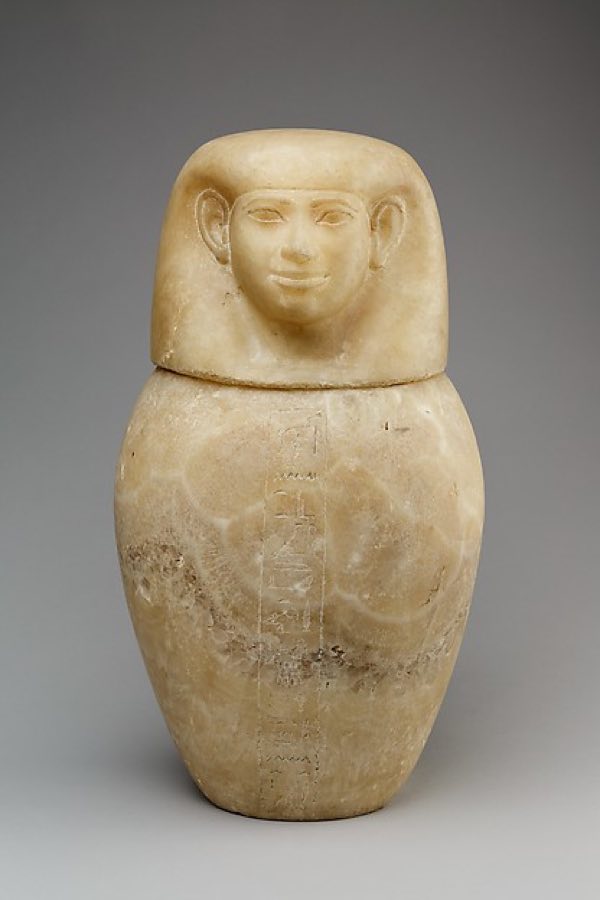
The set of four with Sons of Horus lids and an inscription naming the deceased and protective goddess distinguishes it; Old and Middle Kingdom lids are plain or human-headed. Dummy jars of the Third Intermediate Period are solid. Calcite (Egyptian alabaster) is typical.
Reproductions and fakes
Faked in soft limestone and modern alabaster with crude lids and invented inscriptions; genuine jars show tool marks, weathering and residue inside. Mismatched lids and jars are common.
Photographs
Elsewhere
- met: 544689
Cite this article
Stratum Strata. "Canopic jar" (Artifact type). Stratum Strata pack 2026.09, as of 2026-09-21. https://stratum.black/strata/types/canopic-jar. Accessed 2026-09-21.
@misc{stratum-canopic-jar,
  title        = {Canopic jar},
  author       = {{Stratum Strata}},
  howpublished = {\url{https://stratum.black/strata/types/canopic-jar}},
  year         = {2026},
  note         = {Artifact type article, Stratum Strata pack 2026.09, as of 2026-09-21; sources: stratum, met. Accessed 2026-09-21.}
}
Citations carry the pack version and the article's as-of date so they resolve to the same text later. The facts themselves belong to the sources listed below; cite those for the science.