
Site · Pakistan
Mohenjo-daro
2500–1900 BCE
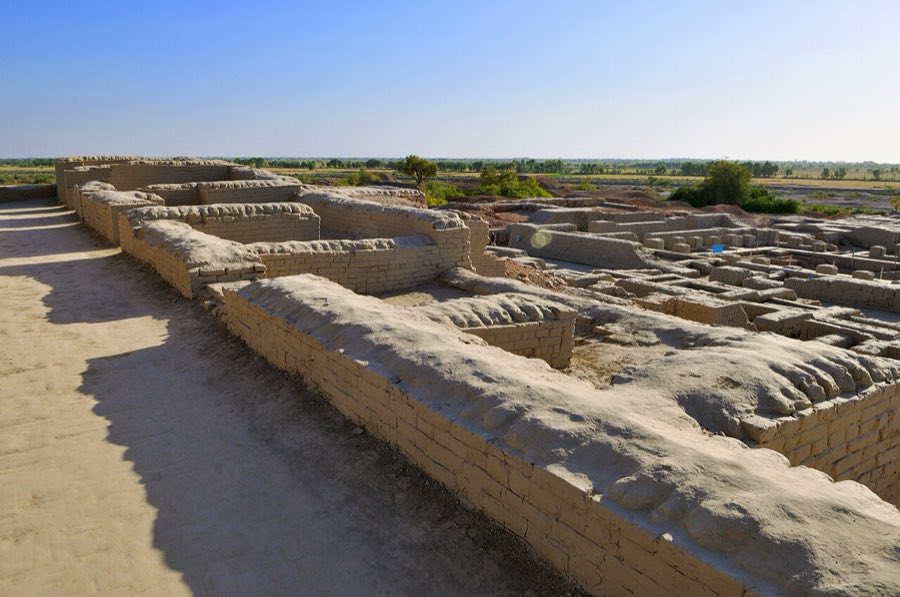
Mohenjo-daro is the largest city of the Indus civilisation, on the Indus in Sindh, built around 2500 BCE on a grid with baked-brick houses, drains and the Great Bath, and abandoned by 1900 BCE. Excavated from 1922, it is threatened by salt and flooding.
| Country | Pakistan |
|---|---|
| State / province | Sindh |
| Dates | 2500–1900 BCE |
| Status | Archaeological site and UNESCO World Heritage Site |
| Managed by | Government of Sindh Department of Culture, Tourism and Antiquities |
| Access | Open to the public with a site museum; salt damage restricts conservation |
| Coordinates | 27.329, 68.138 (public site) |
What was found
Excavations recovered the Priest-King steatite bust, the bronze Dancing Girl, thousands of steatite seals with the undeciphered Indus script, terracotta figurines and carts, weights, beads and the Great Bath. Finds are in the site museum, the National Museum in Karachi and the National Museum of India in Delhi.
Rules
Nothing may be collected, dug, moved or removed at Mohenjo-daro; it is a protected archaeological site managed by Government of Sindh Department of Culture, Tourism and Antiquities, and taking artifacts, stones or samples is an offence. Pakistani law vests all antiquities in the state, and removal or export is a crime. This article is for study and context only and is not a collecting locality.
Elsewhere
- Wikidata: Q5725
- Wikipedia: Mohenjo-daro
Cite this article
Stratum Strata. "Mohenjo-daro" (Site). Stratum Strata pack 2026.09, as of 2026-09-21. https://stratum.black/strata/sites/mohenjo-daro. Accessed 2026-09-21.
@misc{stratum-mohenjo-daro,
  title        = {Mohenjo-daro},
  author       = {{Stratum Strata}},
  howpublished = {\url{https://stratum.black/strata/sites/mohenjo-daro}},
  year         = {2026},
  note         = {Site article, Stratum Strata pack 2026.09, as of 2026-09-21; sources: stratum, wikidata, commons. Accessed 2026-09-21.}
}
Citations carry the pack version and the article's as-of date so they resolve to the same text later. The facts themselves belong to the sources listed below; cite those for the science.