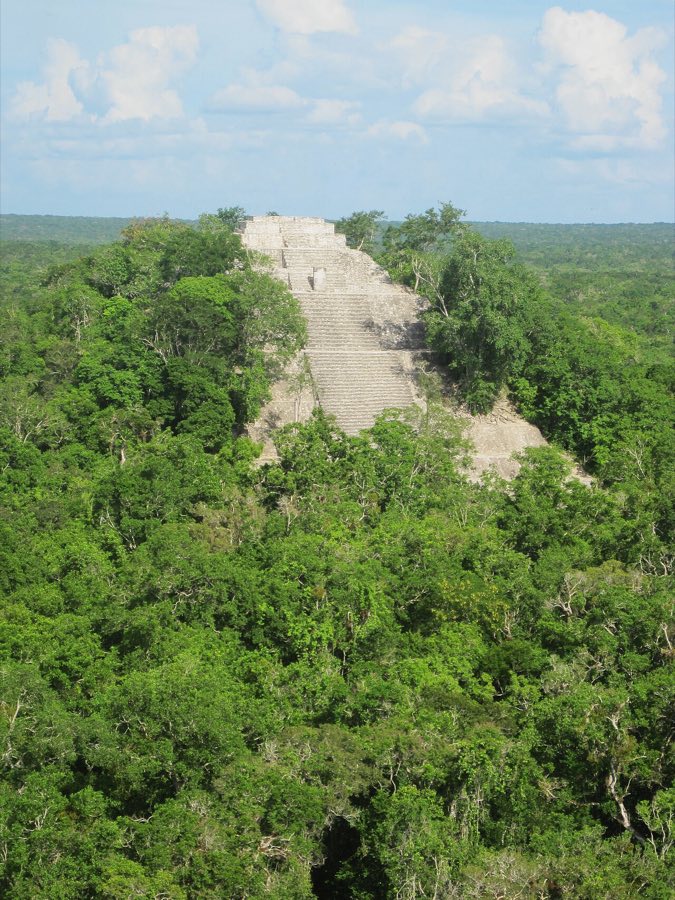

Site · Mexico
Calakmul
Maya, 400 BCE–900 CE
Calakmul was the capital of the Kaan ('Snake') dynasty, the chief rival of Tikal in the Classic period, with a core of over 6,000 structures and Structure II one of the largest Maya pyramids. Its dynasty dominated the lowlands in the seventh century before defeat by Tikal in 695. The site sits deep in the rainforest of southern Campeche and is visited by relatively few.
| Country | Mexico |
|---|---|
| Dates | 400 BCE–900 CE |
| Status | Archaeological Zone within the Calakmul Biosphere Reserve and UNESCO mixed World Heritage Site (2002, extended 2014) |
| Managed by | Instituto Nacional de Antropología e Historia (INAH) and CONANP |
| Access | Reached by a 60-km road through the biosphere reserve from the Escárcega–Chetumal highway; open daily with fees for the reserve and the zone. |
| Coordinates | 18.105, -89.811 (public site) |
What was found
Excavations since the 1980s by Mexican and international teams recorded 117 stelae, royal tombs with jade masks in Structures II and VII, the painted Chiik Nahb murals of market scenes, and Late Classic ceramics; the jade funerary mask of Structure VII is in the Campeche museum.
Rules
Nothing may be collected or removed; Mexico's Federal Law on Monuments and Archaeological, Artistic and Historic Zones (1972) applies, along with biosphere reserve regulations. This article is for study and context only and is not a collecting locality.
Elsewhere
Cite this article
Stratum Strata. "Calakmul" (Site). Stratum Strata pack 2026.09, as of 2026-09-21. https://stratum.black/strata/sites/calakmul. Accessed 2026-09-21.
@misc{stratum-calakmul,
  title        = {Calakmul},
  author       = {{Stratum Strata}},
  howpublished = {\url{https://stratum.black/strata/sites/calakmul}},
  year         = {2026},
  note         = {Site article, Stratum Strata pack 2026.09, as of 2026-09-21; sources: stratum, wikidata, commons. Accessed 2026-09-21.}
}
Citations carry the pack version and the article's as-of date so they resolve to the same text later. The facts themselves belong to the sources listed below; cite those for the science.