
Material · metal
Lead
Europe — Mediterranean, Europe — Western & Central, Europe — Northern & British Isles
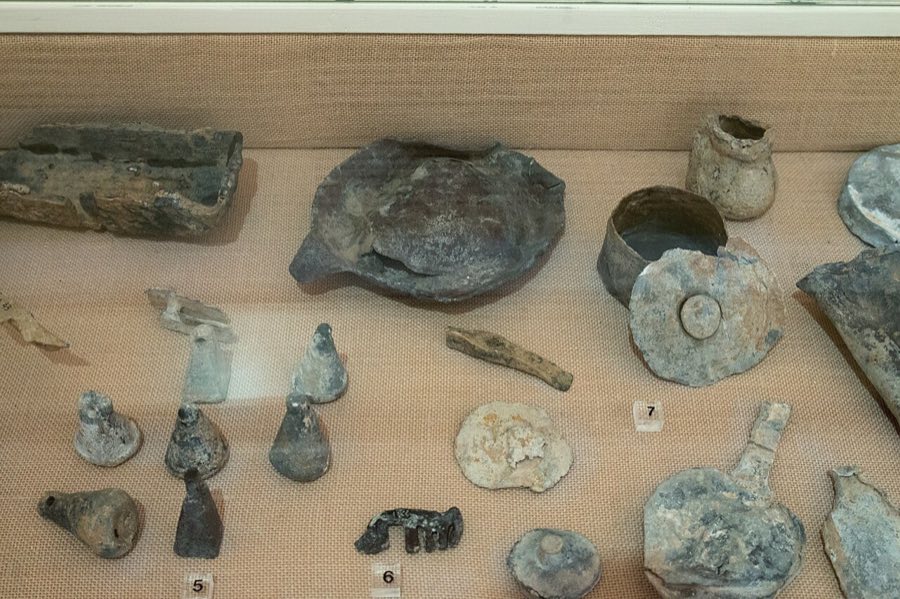
Lead was used by the Romans for water pipes, coffins, weights, sling bullets, curse tablets and pewter, and in medieval and post-medieval Europe for seals, tokens, spindle whorls and cloth seals. It is a common find on Roman and medieval sites in Britain. Lead objects are heavy, soft and dull grey.
| Kind | metal |
|---|---|
| Regions | Europe — Mediterranean, Europe — Western & Central, Europe — Northern & British Isles |
Sources
Roman lead came from the Mendips, Derbyshire, Wales, Spain, Sardinia and Attica; medieval lead from the Peak District and the Mendips. Stamped lead pigs record the mine and the imperial or private owner.
Identification
Ancient lead is soft, heavy and develops a white to grey carbonate crust; inscriptions on curse tablets and stamps on pipes and pigs are the interesting features. Sling bullets are almond-shaped and often inscribed. Isotope analysis sources it.
Substitutes and fakes
Lead is easily cast and inscribed sling bullets, tokens and seals are faked; genuine lead shows a hard, uniform carbonate crust rather than a soft grey surface. Values are low so fraud is limited.
Elsewhere
- Wikidata: Q708
- Wikipedia: lead
Cite this article
Stratum Strata. "Lead" (Material). Stratum Strata pack 2026.09, as of 2026-09-21. https://stratum.black/strata/materials/lead. Accessed 2026-09-21.
@misc{stratum-lead,
  title        = {Lead},
  author       = {{Stratum Strata}},
  howpublished = {\url{https://stratum.black/strata/materials/lead}},
  year         = {2026},
  note         = {Material article, Stratum Strata pack 2026.09, as of 2026-09-21; sources: stratum, commons, wikidata. Accessed 2026-09-21.}
}
Citations carry the pack version and the article's as-of date so they resolve to the same text later. The facts themselves belong to the sources listed below; cite those for the science.