Amulet · Late Period (Egypt)
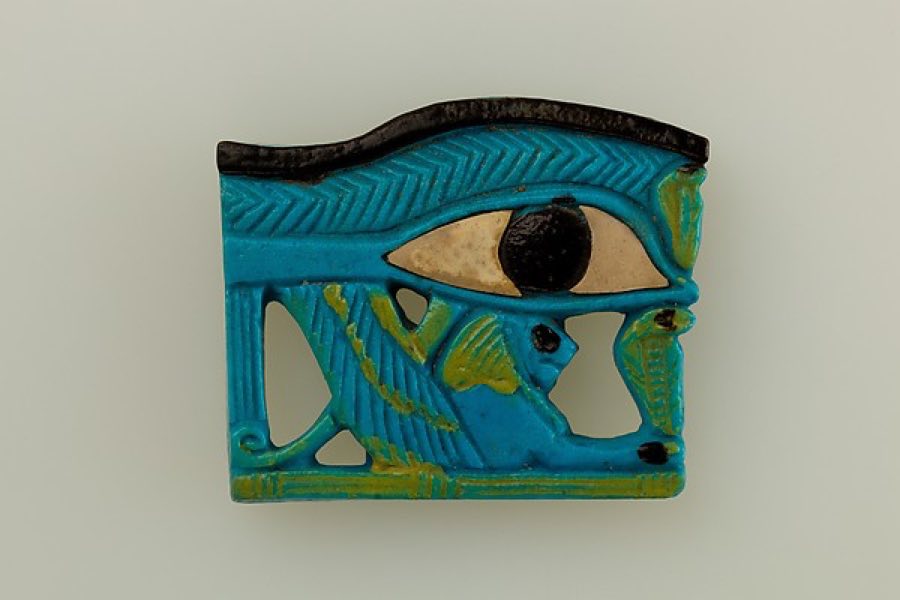
Wedjat eye amulet
1550–30 BCE, Dynastic Egypt
The wedjat is the healed eye of Horus and the single most common Egyptian amulet, placed on the body and among mummy wrappings from the New Kingdom to the Roman period and especially in the Third Intermediate and Late Periods. Faience examples are 10–60 mm long and range from a plain moulded outline to openwork multiples and bright blue-and-black examples with incised detail. Excavated in the thousands, they are the entry point for many Egyptian collectors.
| Object | Amulet |
|---|---|
| Dates | 1550–30 BCE |
| Period | Late Period (Egypt) |
| Cultures | Dynastic Egypt |
| Regions | Egypt & Nile Valley |
Diagnostic traits
A small flat amulet in the form of a stylised human eye with the brow, cosmetic line and the falcon's cheek markings, usually of glazed faience, sometimes stone, glass or gold, pierced for stringing.
Identification
The eye may face left or right and may be doubled or quadrupled; a scarab is a beetle, and the heart and djed amulets are different shapes. Late Period faience is typically pale green or blue-green with sharper moulding than the softer New Kingdom pieces. Roman-period examples become crude and small.
Reproductions and fakes
Modern Egyptian faience wedjats are made in Luxor and Cairo in enormous numbers, generally with a glassy, even bright turquoise glaze and razor-sharp moulded lines; genuine glaze is often crazed, worn on the high points and slightly dull, with a coarse white or buff core visible at the piercing.
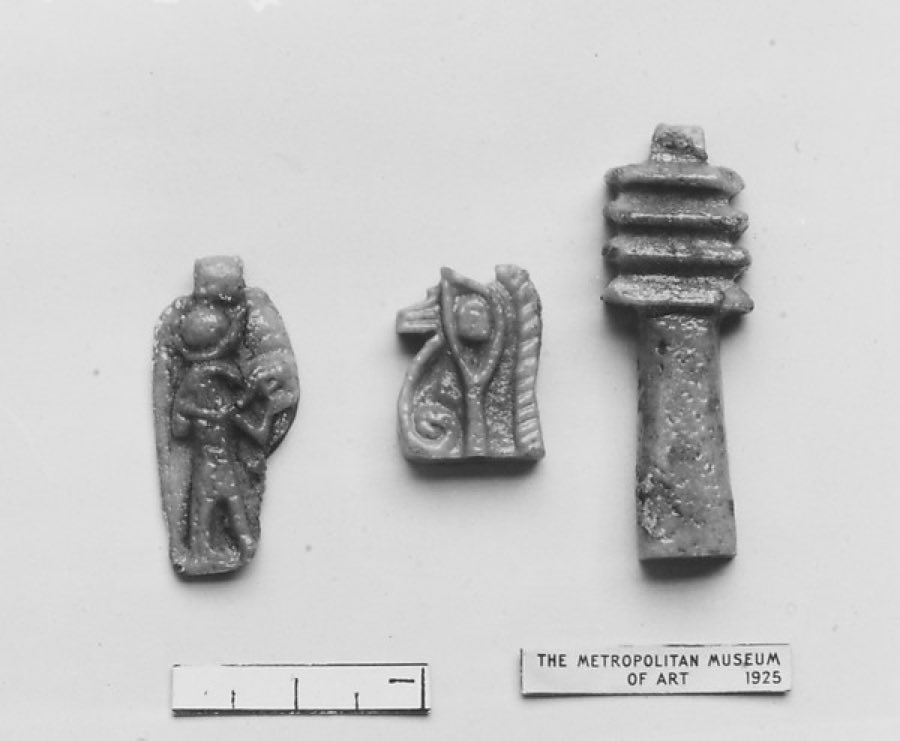
Photographs
Elsewhere
- met: 561047
Cite this article
Stratum Study. "Wedjat eye amulet" (Artifact type). Stratum Study pack 2026.09, as of 2026-09-21. https://stratum.black/study/types/wedjat-eye-amulet. Accessed 2026-09-21.
@misc{stratum-wedjat-eye-amulet,
  title        = {Wedjat eye amulet},
  author       = {{Stratum Study}},
  howpublished = {\url{https://stratum.black/study/types/wedjat-eye-amulet}},
  year         = {2026},
  note         = {Artifact type article, Stratum Study pack 2026.09, as of 2026-09-21; sources: stratum, met. Accessed 2026-09-21.}
}
Citations carry the pack version and the article's as-of date so they resolve to the same text later. The facts themselves belong to the sources listed below; cite those for the science.