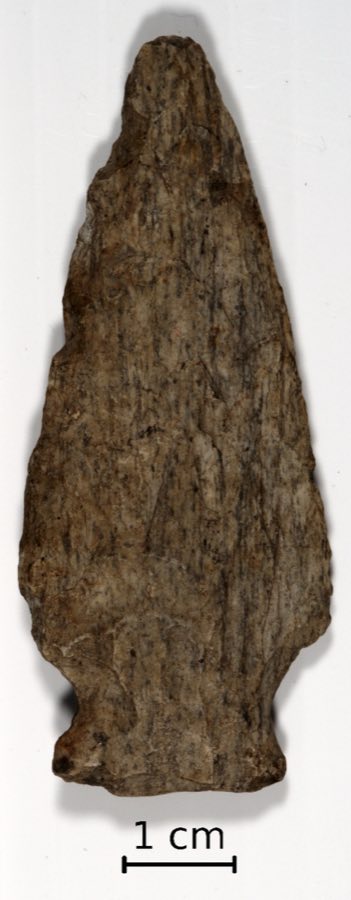

Projectile point · Late Archaic
Susquehanna Broad
1700–700 BCE, Archaic (Eastern)
Susquehanna Broad is the type point of the Susquehanna tradition of the Transitional or Terminal Archaic in Pennsylvania, New York, New Jersey and southern New England, named by Witthoft for the Susquehanna River. It is associated with steatite bowls and the earliest pottery of the region, and was widely made in rhyolite from the Blue Ridge and in Pennsylvania jasper. Broadspears served as knives and are often heavily resharpened, and complete large examples are keenly collected.
| Object | Projectile point |
|---|---|
| Dates | 1700–700 BCE |
| Period | Late Archaic |
| Cultures | Archaic (Eastern) |
| Regions | North America — Eastern Woodlands |
Diagnostic traits
Broad, thin point with a wide triangular blade, sharp angular shoulders and a short, wide expanding stem with a straight or slightly concave base, often made on rhyolite or jasper.
Identification
Susquehanna Broad is thinner and wider than Genesee and has a distinctly expanding rather than straight stem; Perkiomen has an asymmetric, much wider blade and a narrow stem. Orient Fishtail is the smaller, later descendant with a fishtail stem. Lehigh Broad and Koens-Crispin are the related broadspears of the Delaware Valley with straighter stems.
Reproductions and fakes
Rhyolite reproductions are sold as broadspears; genuine rhyolite shows a weathered, slightly chalky surface with differential weathering of the phenocrysts, which fresh flaking lacks.
Elsewhere
- Wikidata: Q138715503
Cite this article
Stratum Study. "Susquehanna Broad" (Artifact type). Stratum Study pack 2026.09, as of 2026-09-21. https://stratum.black/study/types/susquehanna-broad. Accessed 2026-09-21.
@misc{stratum-susquehanna-broad,
  title        = {Susquehanna Broad},
  author       = {{Stratum Study}},
  howpublished = {\url{https://stratum.black/study/types/susquehanna-broad}},
  year         = {2026},
  note         = {Artifact type article, Stratum Study pack 2026.09, as of 2026-09-21; sources: stratum, wikidata, commons. Accessed 2026-09-21.}
}
Citations carry the pack version and the article's as-of date so they resolve to the same text later. The facts themselves belong to the sources listed below; cite those for the science.