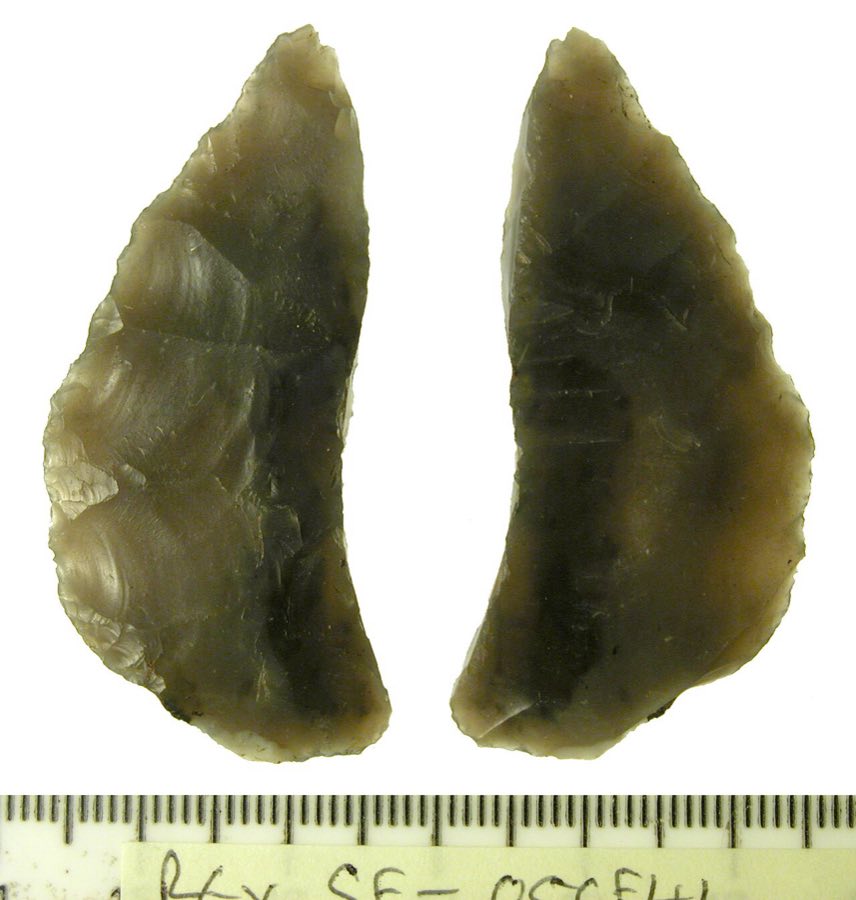

Biface · Upper Palaeolithic
Solutrean laurel leaf
22000–17000 BCE, Solutrean
The Solutrean laurel leaf is the thin, symmetrical bifacial point of France and Iberia from about 22,000 to 17,000 years ago, made by heat treatment and pressure flaking. Some are so large and fragile that they must have been ceremonial, notably the Volgu cache. Willow leaves and shouldered points are related forms.
| Object | Biface |
|---|---|
| Dates | 22000–17000 BCE |
| Period | Upper Palaeolithic |
| Cultures | Solutrean |
| Regions | Europe — Western & Central |
Diagnostic traits
Very thin, symmetrical bifacial leaf point finished by pressure flaking; some are too large and fragile for use.
Identification
Laurel leaves are thin, symmetrical and pressure-flaked with parallel scars, unlike Acheulean handaxes, which are thick and percussion-flaked, and unlike Clovis bifaces, which are fluted or overshot-flaked. Heat-treated flint shows a waxy lustre. Shouldered points have an asymmetric tang.
Reproductions and fakes
Among the most reproduced Palaeolithic objects, with modern knappers matching the originals; the difference lies in patina, sediment in scars and provenance. Copper-tipped modern pressure tools leave small crescent initiations.
Cite this article
Stratum Study. "Solutrean laurel leaf" (Artifact type). Stratum Study pack 2026.09, as of 2026-09-21. https://stratum.black/study/types/solutrean-laurel-leaf. Accessed 2026-09-21.
@misc{stratum-solutrean-laurel-leaf,
  title        = {Solutrean laurel leaf},
  author       = {{Stratum Study}},
  howpublished = {\url{https://stratum.black/study/types/solutrean-laurel-leaf}},
  year         = {2026},
  note         = {Artifact type article, Stratum Study pack 2026.09, as of 2026-09-21; sources: stratum, commons. Accessed 2026-09-21.}
}
Citations carry the pack version and the article's as-of date so they resolve to the same text later. The facts themselves belong to the sources listed below; cite those for the science.