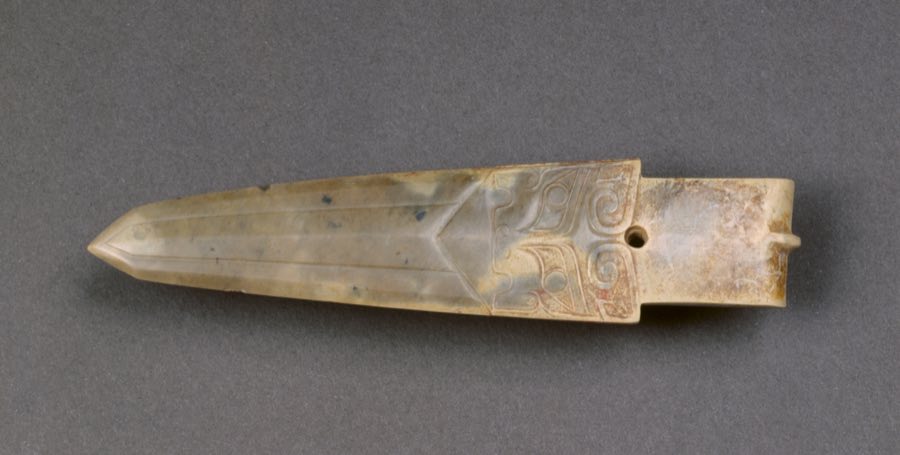
Axe head · Shang
Shang ge dagger-axe
1600–221 BCE, Imperial China
The ge is the standard weapon of Shang and Zhou armies from about 1600 BCE to the unification under Qin, found in the hundreds in royal tombs at Anyang and in Zhou aristocratic burials. Shang blades are short and straight with a simple tang and sometimes a jade blade for ritual; Warring States blades are longer with a prominent hu and up to four holes for binding. Lengths run from 150 to 300 mm; inscribed or gilt examples are rare.
| Object | Axe head |
|---|---|
| Dates | 1600–221 BCE |
| Period | Shang |
| Cultures | Imperial China |
| Regions | East Asia |
Diagnostic traits
A cast bronze blade with a pointed, slightly curved main blade (yuan), a tang (nei) at right angles to the shaft, and in later forms a downward-extending hu with lashing holes, mounted crosswise on a long pole.
Identification
A ge has its tang at right angles to the blade, unlike a dagger; a ji combines a ge with a spear point on the same shaft; a yue is a broad ceremonial axe. Zhou and Warring States forms are recognised by the long hu and its lashing holes, absent on Shang examples.
Reproductions and fakes
Chinese reproduction bronzes are abundant, cast in modern alloy with a painted green-and-blue patina that is uniform and chalky; genuine patina is hard, layered and often has cuprite red and earthen encrustation in the recesses, and the tang shows wear from the shaft. Jade ge are also copied; look for calcification and genuine tool marks.
Cite this article
Stratum Study. "Shang ge dagger-axe" (Artifact type). Stratum Study pack 2026.09, as of 2026-09-21. https://stratum.black/study/types/shang-ge-dagger-axe. Accessed 2026-09-21.
@misc{stratum-shang-ge-dagger-axe,
  title        = {Shang ge dagger-axe},
  author       = {{Stratum Study}},
  howpublished = {\url{https://stratum.black/study/types/shang-ge-dagger-axe}},
  year         = {2026},
  note         = {Artifact type article, Stratum Study pack 2026.09, as of 2026-09-21; sources: stratum, cleveland. Accessed 2026-09-21.}
}
Citations carry the pack version and the article's as-of date so they resolve to the same text later. The facts themselves belong to the sources listed below; cite those for the science.