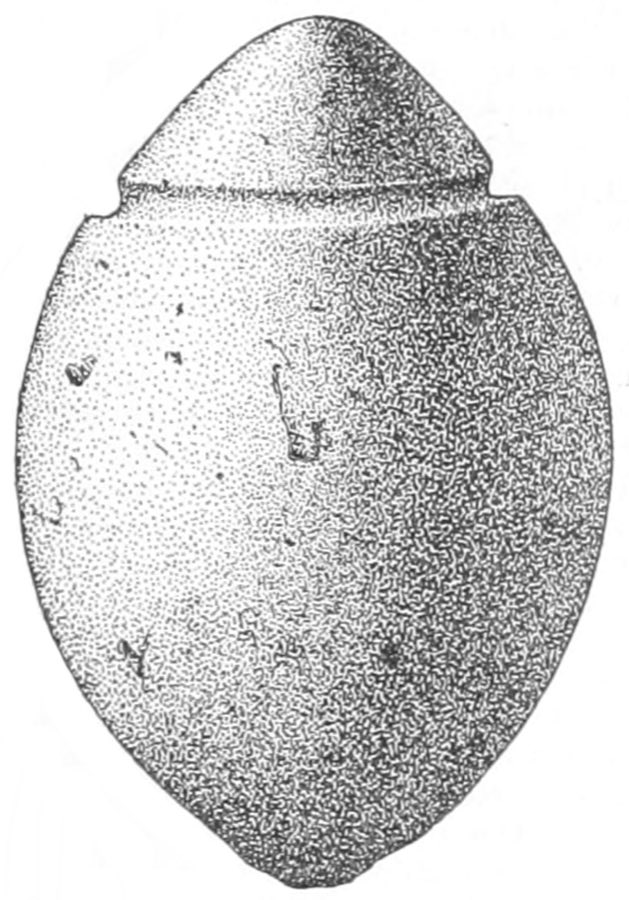

Plummet · Late Archaic
Plummet
3000–1000 BCE, Poverty Point, Archaic (Eastern)
The plummet is a teardrop or egg-shaped ground-stone weight with a groove or hole at the narrow end, made in the Late Archaic Southeast and Eastern Woodlands, about 3,000 to 1,000 BCE, and famous from Poverty Point in hematite. It served as a net or line weight or as a bola. Hematite examples are heavy and highly polished.
| Object | Plummet |
|---|---|
| Dates | 3000–1000 BCE |
| Period | Late Archaic |
| Cultures | Poverty Point, Archaic (Eastern) |
| Regions | North America — Southeast, North America — Eastern Woodlands |
Diagnostic traits
Teardrop or egg-shaped weight with a groove or drilled hole at the narrow end; hematite typical at Poverty Point.
Identification
Plummets are grooved or drilled at one end and taper toward it, unlike bannerstones, which are drilled through the length, and boatstones, which are hollowed. Poverty Point examples in hematite and magnetite are often decorated with incised lines. Materials also include steatite and limestone.
Reproductions and fakes
Hematite plummets are reproduced on grinders; genuine pieces show pecking and a hand polish with slight facets. Modern drill holes are cylindrical.
Cite this article
Stratum Study. "Plummet" (Artifact type). Stratum Study pack 2026.09, as of 2026-09-21. https://stratum.black/study/types/plummet. Accessed 2026-09-21.
@misc{stratum-plummet,
  title        = {Plummet},
  author       = {{Stratum Study}},
  howpublished = {\url{https://stratum.black/study/types/plummet}},
  year         = {2026},
  note         = {Artifact type article, Stratum Study pack 2026.09, as of 2026-09-21; sources: stratum, commons. Accessed 2026-09-21.}
}
Citations carry the pack version and the article's as-of date so they resolve to the same text later. The facts themselves belong to the sources listed below; cite those for the science.