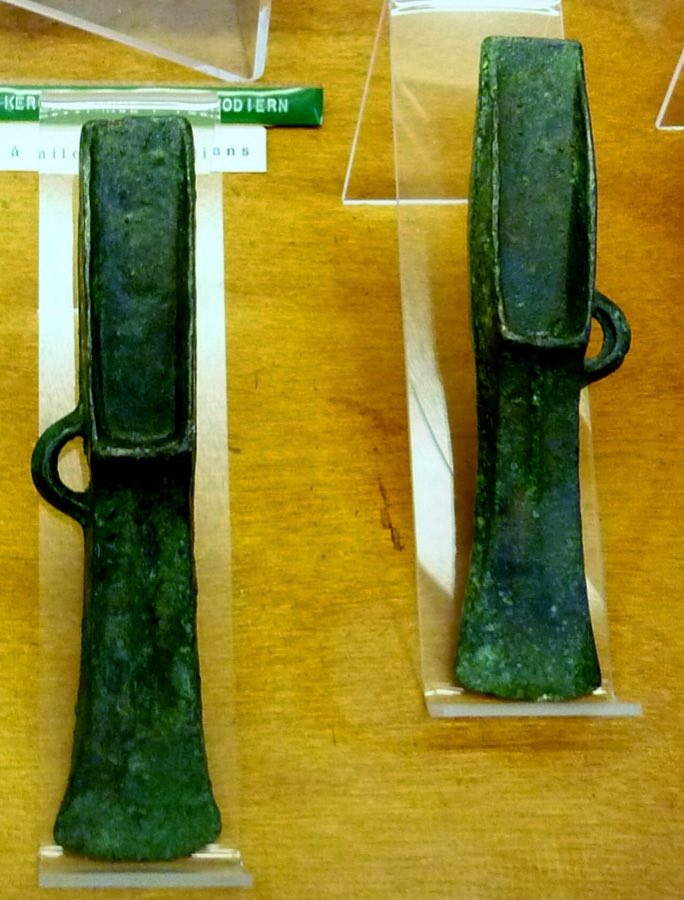

Axe head · Middle Bronze Age
Palstave
1600–1200 BCE
The palstave is the Middle Bronze Age axe of western and central Europe, about 1,600 to 1,200 BCE, with cast flanges and a stop-ridge that seat a split wooden haft. It replaced the flanged axe and was replaced by the socketed axe. Hoards of palstaves are common in Britain and France.
| Object | Axe head |
|---|---|
| Dates | 1600–1200 BCE |
| Period | Middle Bronze Age |
| Regions | Europe — Western & Central, Europe — Northern & British Isles |
Diagnostic traits
Bronze axe with high cast flanges and a stop-ridge to seat the split haft; some have a side loop and a shield or midrib below the stop.
Identification
Palstaves have high flanges and a stop-ridge, and sometimes a side loop and a shield or midrib below the stop, unlike flat axes, which have none, and socketed axes, which are hollow. Early palstaves are shield-pattern; late ones have a narrow blade and low flanges. Regional types include Werrar and Acton Park.
Reproductions and fakes
Modern casts with chemical patina are common online; genuine palstaves show casting seams filed off, hammered blade edges and a hard layered patina. Look for the wear of the stop-ridge.
Elsewhere
- Wikidata: Q3888353
- Wikipedia: palstave
Cite this article
Stratum Study. "Palstave" (Artifact type). Stratum Study pack 2026.09, as of 2026-09-21. https://stratum.black/study/types/palstave. Accessed 2026-09-21.
@misc{stratum-palstave,
  title        = {Palstave},
  author       = {{Stratum Study}},
  howpublished = {\url{https://stratum.black/study/types/palstave}},
  year         = {2026},
  note         = {Artifact type article, Stratum Study pack 2026.09, as of 2026-09-21; sources: stratum, wikidata, commons. Accessed 2026-09-21.}
}
Citations carry the pack version and the article's as-of date so they resolve to the same text later. The facts themselves belong to the sources listed below; cite those for the science.