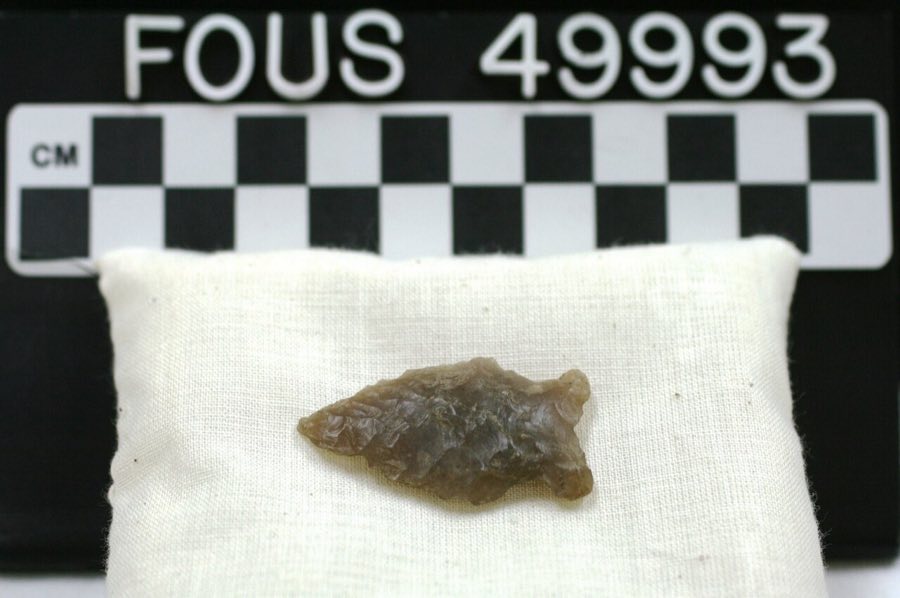

Projectile point · Middle Archaic
Oxbow
3200–1100 BCE, Plains Archaic
Oxbow was named by Nero and McCorquodale in 1958 from the Oxbow Dam site in Saskatchewan and defines a Middle Plains Archaic complex across the northern Plains from Saskatchewan and Alberta into Montana and the Dakotas. Knife River flint, Swan River chert and quartzite are common. It is a frequent find on Canadian prairie sites.
| Object | Projectile point |
|---|---|
| Dates | 3200–1100 BCE |
| Period | Middle Archaic |
| Cultures | Plains Archaic |
| Regions | North America — Great Plains |
Diagnostic traits
Small side-notched point with a deeply concave base that leaves prominent rounded ears, wide shallow notches, a ground base and a short triangular blade.
Identification
Oxbow's deeply concave eared base separates it from McKean, which is unnotched, and from Mummy Cave and Hawken, whose bases are straight or only slightly concave. Mallory is a related McKean-complex form with a less concave base.
Reproductions and fakes
Not reproduced.
Cite this article
Stratum Study. "Oxbow" (Artifact type). Stratum Study pack 2026.09, as of 2026-09-21. https://stratum.black/study/types/oxbow. Accessed 2026-09-21.
@misc{stratum-oxbow,
  title        = {Oxbow},
  author       = {{Stratum Study}},
  howpublished = {\url{https://stratum.black/study/types/oxbow}},
  year         = {2026},
  note         = {Artifact type article, Stratum Study pack 2026.09, as of 2026-09-21; sources: stratum, commons. Accessed 2026-09-21.}
}
Citations carry the pack version and the article's as-of date so they resolve to the same text later. The facts themselves belong to the sources listed below; cite those for the science.