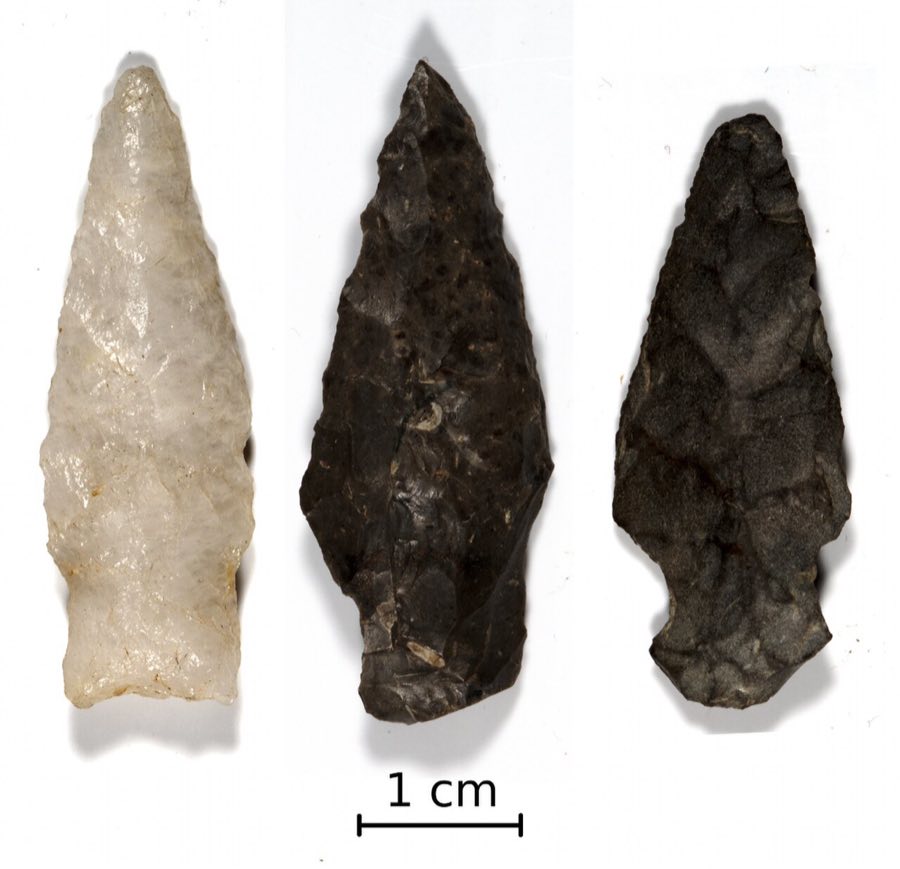

Projectile point · Late Archaic
Lamoka
3500–2500 BCE, Archaic (Eastern)
Lamoka is the type point of the Lamoka phase, defined by William Ritchie at the Lamoka Lake site in Schuyler County, New York, and is among the most abundant Late Archaic points of New York and Pennsylvania. Most are made from local Onondaga chert or pebble cherts and are thick and narrow, sometimes with cortex left on the base. They come in great numbers from Finger Lakes and Susquehanna sites and are inexpensive, though good Lamoka Lake provenience adds value.
| Object | Projectile point |
|---|---|
| Dates | 3500–2500 BCE |
| Period | Late Archaic |
| Cultures | Archaic (Eastern) |
| Regions | North America — Eastern Woodlands |
Diagnostic traits
Small, thick, narrow point with a straight to slightly convex blade, weak shoulders and a short, narrow straight or slightly contracting stem, usually crudely flaked with the base often unfinished.
Identification
Lamoka is smaller and cruder than Bare Island and Lackawaxen, both narrow stemmed types of the Susquehanna, and lacks the fine flaking of Normanskill. The unfinished, often cortex-bearing base and thick section are the key marks. Sylvan Lake Stemmed and Wading River are the closely related narrow-stemmed points of the Hudson and Long Island.
Reproductions and fakes
Seldom faked, but genuine ones are sometimes misattributed as Paleoindian or Woodland; authentic Lamokas show a gray-brown patina on Onondaga chert and a rough, unground base.
Elsewhere
- Wikidata: Q6482156
- Wikipedia: Lamoka projectile point
Cite this article
Stratum Study. "Lamoka" (Artifact type). Stratum Study pack 2026.09, as of 2026-09-21. https://stratum.black/study/types/lamoka. Accessed 2026-09-21.
@misc{stratum-lamoka,
  title        = {Lamoka},
  author       = {{Stratum Study}},
  howpublished = {\url{https://stratum.black/study/types/lamoka}},
  year         = {2026},
  note         = {Artifact type article, Stratum Study pack 2026.09, as of 2026-09-21; sources: stratum, wikidata, commons. Accessed 2026-09-21.}
}
Citations carry the pack version and the article's as-of date so they resolve to the same text later. The facts themselves belong to the sources listed below; cite those for the science.