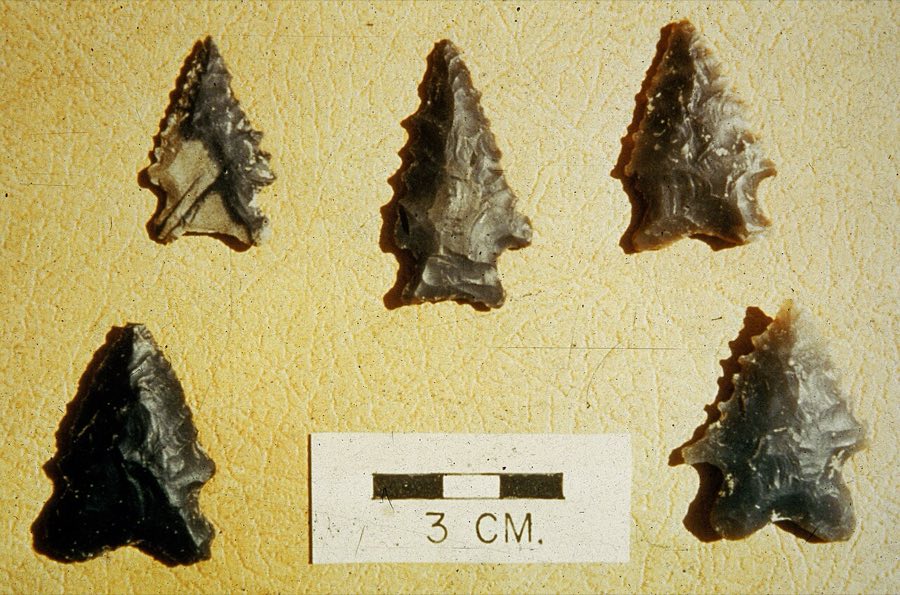

Projectile point · Early Archaic
Kirk Serrated
7000–6000 BCE, Archaic (Eastern)
Kirk Serrated was named by Coe from the Hardaway site and defined more closely by Broyles at the St. Albans site, where it dates late in the Early Archaic. It is the last of the Kirk-cluster forms and is found throughout the Southeast and the Ohio Valley. Rhyolite, Fort Payne chert and Flint Ridge flint are typical.
| Object | Projectile point |
|---|---|
| Dates | 7000–6000 BCE |
| Period | Early Archaic |
| Cultures | Archaic (Eastern) |
| Regions | North America — Southeast, North America — Eastern Woodlands |
Diagnostic traits
Stemmed point with coarse, deep serrations along the entire blade, a straight to slightly expanding stem, a straight or slightly concave base and weak, rounded shoulders.
Identification
Kirk Serrated differs from Kirk Stemmed only in the coarseness of its serrations and a tendency to an expanding stem; the two are often lumped. Stanly has a small notched-base stem and a broad blade; Kanawha is bifurcate.
Reproductions and fakes
As for Kirk Stemmed: reproduced serrations are fresh and sharp, and stems lack grinding.
Elsewhere
- Wikidata: Q138712802
Cite this article
Stratum Study. "Kirk Serrated" (Artifact type). Stratum Study pack 2026.09, as of 2026-09-21. https://stratum.black/study/types/kirk-serrated. Accessed 2026-09-21.
@misc{stratum-kirk-serrated,
  title        = {Kirk Serrated},
  author       = {{Stratum Study}},
  howpublished = {\url{https://stratum.black/study/types/kirk-serrated}},
  year         = {2026},
  note         = {Artifact type article, Stratum Study pack 2026.09, as of 2026-09-21; sources: stratum, wikidata, commons. Accessed 2026-09-21.}
}
Citations carry the pack version and the article's as-of date so they resolve to the same text later. The facts themselves belong to the sources listed below; cite those for the science.