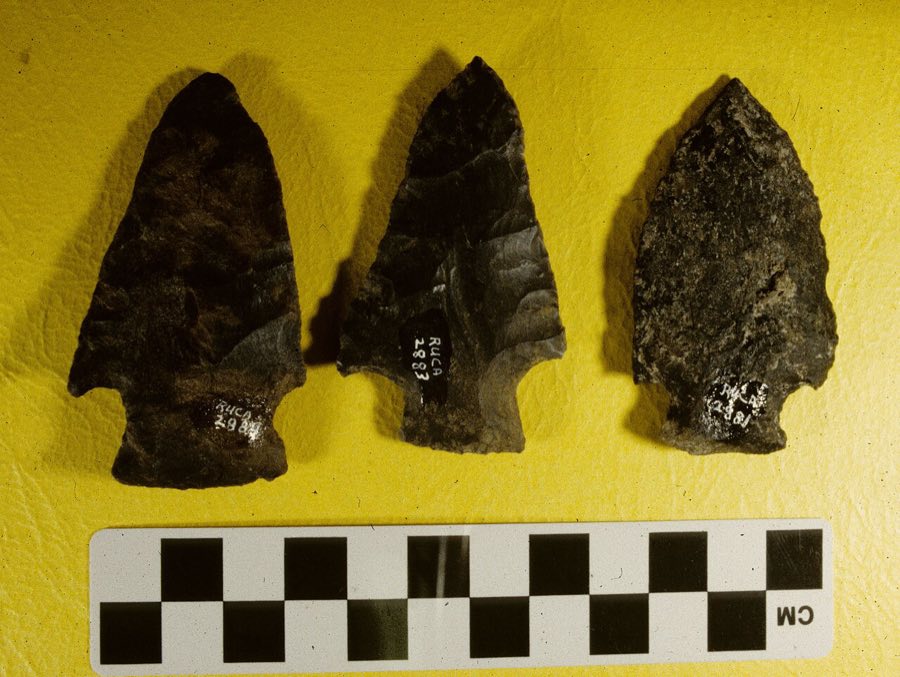

Projectile point · Early Archaic
Kirk Corner Notched
7500–6500 BCE, Archaic (Eastern)
The Kirk Corner Notched point is the hallmark of the Early Archaic across the Eastern Woodlands and Southeast, about 7,500 to 6,500 BCE, named after a site on the Hardaway sequence. It is among the most common Early Archaic finds and was used as a dart point and knife. Large and small varieties are recognised.
| Object | Projectile point |
|---|---|
| Dates | 7500–6500 BCE |
| Period | Early Archaic |
| Cultures | Archaic (Eastern) |
| Regions | North America — Eastern Woodlands, North America — Southeast |
Diagnostic traits
Large corner-notched point with a straight or convex base and serrated blade edges; barbs prominent.
Identification
Kirk has deep corner notches, prominent barbs, a straight or slightly convex unground base and serrated blade edges, which separates it from Palmer, smaller with a ground base, and from Lost Lake and Thebes, which have alternate bevelling. Charleston and Pine Tree are closely related. It lacks the expanding, ground stem of St. Charles.
Reproductions and fakes
Kirk points are reproduced but rarely with much effort because of moderate values; fakes have uniform serrations and fresh scars. Genuine examples commonly show heavy resharpening that narrows the blade above wide barbs.
Elsewhere
- Wikidata: Q138712801
Cite this article
Stratum Study. "Kirk Corner Notched" (Artifact type). Stratum Study pack 2026.09, as of 2026-09-21. https://stratum.black/study/types/kirk-corner-notched. Accessed 2026-09-21.
@misc{stratum-kirk-corner-notched,
  title        = {Kirk Corner Notched},
  author       = {{Stratum Study}},
  howpublished = {\url{https://stratum.black/study/types/kirk-corner-notched}},
  year         = {2026},
  note         = {Artifact type article, Stratum Study pack 2026.09, as of 2026-09-21; sources: stratum, wikidata, commons. Accessed 2026-09-21.}
}
Citations carry the pack version and the article's as-of date so they resolve to the same text later. The facts themselves belong to the sources listed below; cite those for the science.