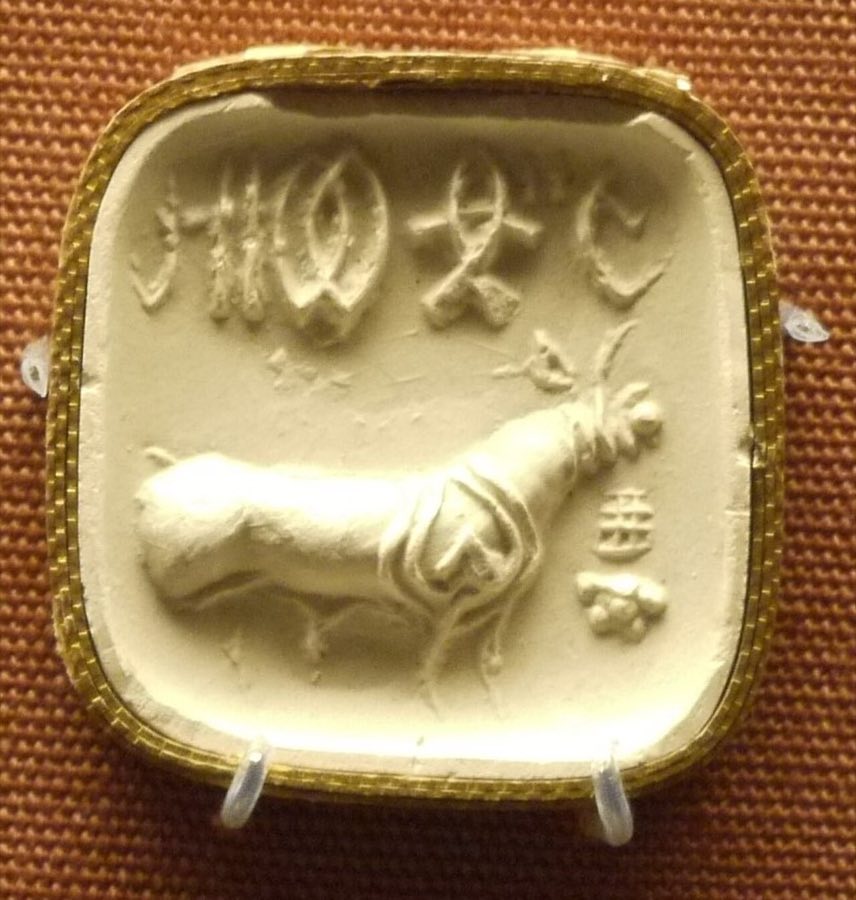

Seal · Harappan
Indus stamp seal
2600–1900 BCE, Indus Valley
Indus seals are the emblem of the Mature Harappan civilisation, excavated in the thousands at Mohenjo-daro, Harappa and other cities between about 2600 and 1900 BCE. They were cut in steatite, fired to whiten and harden the surface, and used to seal goods; a few have been found in Mesopotamia and the Gulf. Seals with the unicorn are most common, followed by the zebu, elephant, rhinoceros and tiger; the seated horned figure seals are exceptional.
| Object | Seal |
|---|---|
| Dates | 2600–1900 BCE |
| Period | Harappan |
| Cultures | Indus Valley |
| Regions | Near East & Mesopotamia, Central Asia & Steppe |
Diagnostic traits
A square steatite seal about 20–40 mm across with a perforated boss on the back, engraved intaglio with an animal (usually a 'unicorn' bull before a standard) and a line of undeciphered Indus script above.
Identification
A Mesopotamian stamp seal is domed or conoid and uses different iconography; Indus seals are square with the perforated boss. Later 'Indus-style' seals from Bahrain (Dilmun) are round. The script above the animal and the animal-and-standard composition are unmistakable.
Reproductions and fakes
Modern seals cut in Pakistan and India are made in steatite and sold to tourists and online in large numbers; they have crisp, glassy surfaces, invented script sequences and a boss that shows no string wear. Genuine seals have a matte whitened surface, wear at the perforation and correct sign forms. Export from Pakistan and India is prohibited under their antiquities acts.
Cite this article
Stratum Study. "Indus stamp seal" (Artifact type). Stratum Study pack 2026.09, as of 2026-09-21. https://stratum.black/study/types/indus-stamp-seal. Accessed 2026-09-21.
@misc{stratum-indus-stamp-seal,
  title        = {Indus stamp seal},
  author       = {{Stratum Study}},
  howpublished = {\url{https://stratum.black/study/types/indus-stamp-seal}},
  year         = {2026},
  note         = {Artifact type article, Stratum Study pack 2026.09, as of 2026-09-21; sources: stratum, commons. Accessed 2026-09-21.}
}
Citations carry the pack version and the article's as-of date so they resolve to the same text later. The facts themselves belong to the sources listed below; cite those for the science.