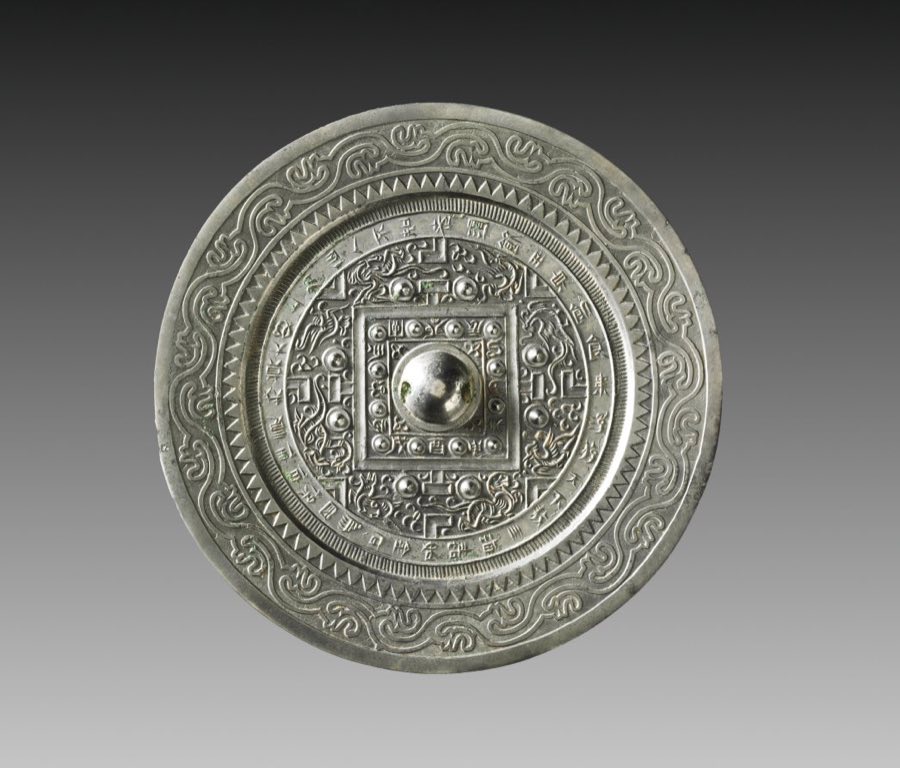
Mirror · Han
Han bronze mirror
206 BCE–220 CE, Imperial China
The Han bronze mirror is the cast disc with a polished reflective face and a decorated back bearing a central knob, made from 206 BCE to 220 CE and placed in tombs. TLV cosmological designs, cloud scrolls, inscriptions and later animal bands are characteristic. Mirrors are among the most collected Chinese bronzes.
| Object | Mirror |
|---|---|
| Dates | 206 BCE–220 CE |
| Period | Han |
| Cultures | Imperial China |
| Regions | East Asia |
Diagnostic traits
Cast bronze disc with a polished face and a decorated back bearing a central knob; TLV, cloud-scroll and inscribed bands are typical.
Identification
The high-tin bronze with a silvery surface, central pierced knob and concentric bands of TLV, nipple and inscription patterns distinguish it from Warring States mirrors, which are thinner with a small knob, and from Tang mirrors, which are lobed with lions and grapes. Diameter is 8 to 20 cm. Patina is often silvery or green.
Reproductions and fakes
Cast from genuine mirrors and patinated; fakes have soft detail and a painted or chemical patina. Genuine mirrors show casting flaws and layered corrosion.
Cite this article
Stratum Study. "Han bronze mirror" (Artifact type). Stratum Study pack 2026.09, as of 2026-09-21. https://stratum.black/study/types/han-bronze-mirror. Accessed 2026-09-21.
@misc{stratum-han-bronze-mirror,
  title        = {Han bronze mirror},
  author       = {{Stratum Study}},
  howpublished = {\url{https://stratum.black/study/types/han-bronze-mirror}},
  year         = {2026},
  note         = {Artifact type article, Stratum Study pack 2026.09, as of 2026-09-21; sources: stratum, cleveland. Accessed 2026-09-21.}
}
Citations carry the pack version and the article's as-of date so they resolve to the same text later. The facts themselves belong to the sources listed below; cite those for the science.