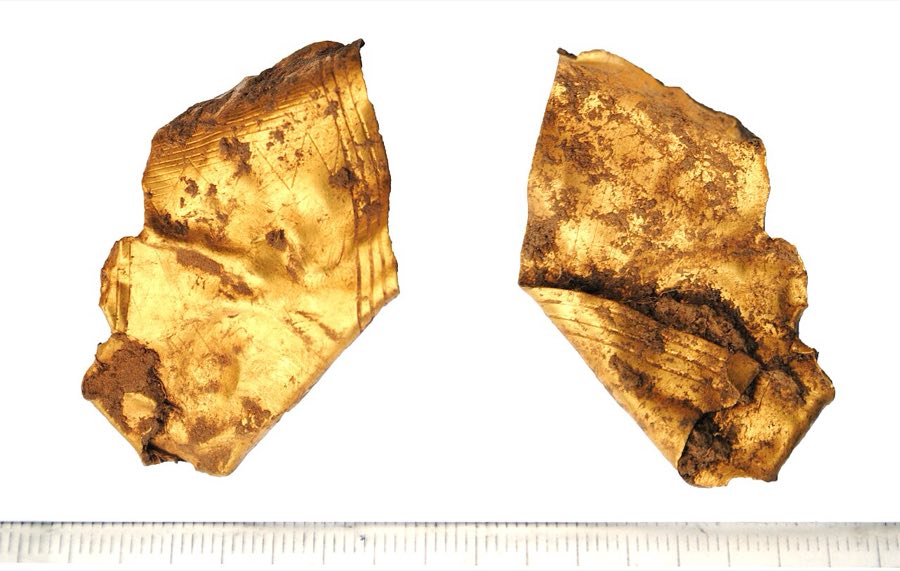

Torc · Early Bronze Age
Gold lunula
2200–1800 BCE, Bell Beaker
Lunulae are an Early Bronze Age Irish speciality, with over 80 known from Ireland and a scatter in Cornwall, Wales, Scotland, Brittany and Denmark. They are made from a few grams of gold hammered to foil, and their chevron and lozenge ornament copies the pottery and jet necklaces of the Bell Beaker horizon. Nearly all are in national museums; the few in private hands are exceptionally rare and any new find in Ireland or Britain is treasure.
| Object | Torc |
|---|---|
| Dates | 2200–1800 BCE |
| Period | Early Bronze Age |
| Cultures | Bell Beaker |
| Regions | Europe — Northern & British Isles |
Diagnostic traits
A crescent-shaped collar of thin beaten sheet gold, widest at the centre and tapering to small flat terminal discs turned at right angles, decorated with fine incised geometric bands at the horns.
Identification
The turned flat terminals and the concentration of decoration at the horns rather than the centre distinguish a lunula from the later Bronze Age gorget, which has raised ribs and separate disc terminals, and from a plain sheet-gold collar. Taylor's classes are Classical (thin, finely decorated), Unaccomplished (cruder) and Provincial (thicker, found outside Ireland).
Reproductions and fakes
Modern gold lunulae are made for jewellery and for the fake trade; genuine gold shows no patina but should show tool marks from hammering, slight irregularity in the incised lines and ancient crease damage. Any lunula offered without a documented pre-1990s provenance should be presumed either modern or unlawfully removed.
Cite this article
Stratum Study. "Gold lunula" (Artifact type). Stratum Study pack 2026.09, as of 2026-09-21. https://stratum.black/study/types/gold-lunula. Accessed 2026-09-21.
@misc{stratum-gold-lunula,
  title        = {Gold lunula},
  author       = {{Stratum Study}},
  howpublished = {\url{https://stratum.black/study/types/gold-lunula}},
  year         = {2026},
  note         = {Artifact type article, Stratum Study pack 2026.09, as of 2026-09-21; sources: stratum, commons. Accessed 2026-09-21.}
}
Citations carry the pack version and the article's as-of date so they resolve to the same text later. The facts themselves belong to the sources listed below; cite those for the science.