
Projectile point · Paleoindian
Folsom
10800–10200 BCE, Folsom
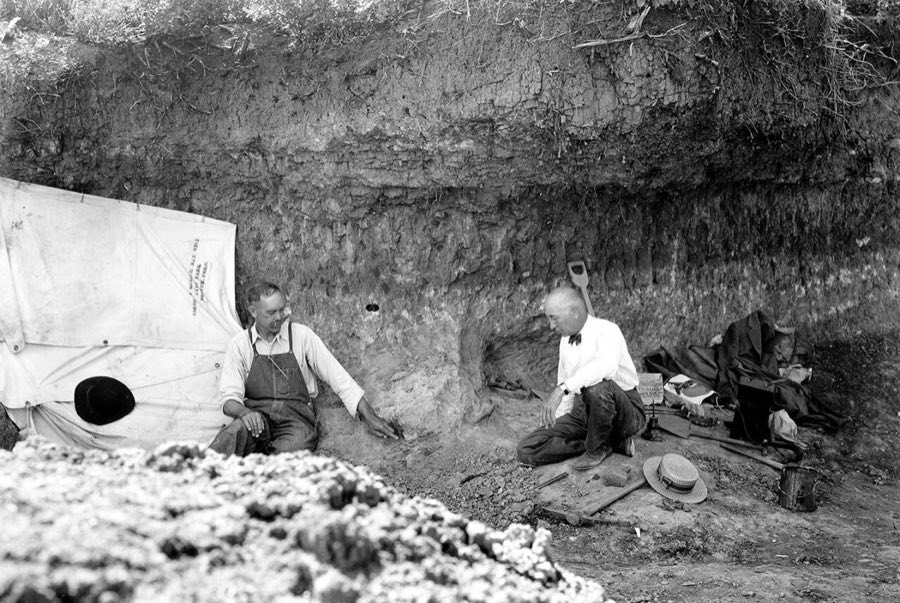
The Folsom point is the finely made fluted dart point of Great Plains and Southwestern bison hunters from about 10,800 to 10,200 BCE, first found among extinct bison bones in New Mexico in 1927. Its manufacture demanded extreme skill and many broke in the fluting. Complete examples are rare and prized.
| Object | Projectile point |
|---|---|
| Dates | 10800–10200 BCE |
| Period | Paleoindian |
| Cultures | Folsom |
| Regions | North America — Great Plains, North America — Southwest |
Diagnostic traits
Small, thin lanceolate; flutes run nearly the full face; fine pressure retouch on edges; basal ears.
Identification
Folsom differs from Clovis in being smaller, thinner and fluted nearly the full length of each face, leaving a narrow margin of tiny pressure flakes along the edges and small basal ears. Midland points are the same outline without flutes, and Goshen/Plainview points are unfluted with basal thinning. The channel flake itself is a diagnostic by-product.
Reproductions and fakes
Fakes are less common than for Clovis because full-length fluting on a thin blank usually breaks, but they exist; they are typically too thick, with flutes that hinge out early and edges without the marginal retouch. Broken genuine bases re-tipped by modern hands are a known trick, so compare patina on base and blade.
Elsewhere
- Wikidata: Q5464871
- Wikipedia: Folsom point
Cite this article
Stratum Study. "Folsom" (Artifact type). Stratum Study pack 2026.09, as of 2026-09-21. https://stratum.black/study/types/folsom. Accessed 2026-09-21.
@misc{stratum-folsom,
  title        = {Folsom},
  author       = {{Stratum Study}},
  howpublished = {\url{https://stratum.black/study/types/folsom}},
  year         = {2026},
  note         = {Artifact type article, Stratum Study pack 2026.09, as of 2026-09-21; sources: stratum, wikidata, commons. Accessed 2026-09-21.}
}
Citations carry the pack version and the article's as-of date so they resolve to the same text later. The facts themselves belong to the sources listed below; cite those for the science.