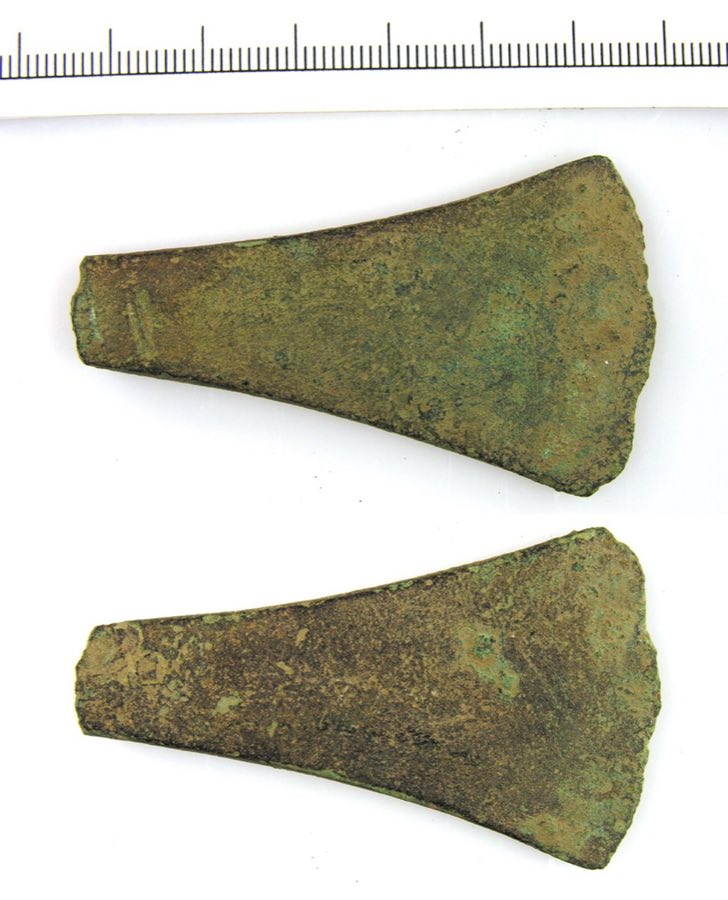

Axe head · Early Bronze Age
Flat axe
2500–1600 BCE, Únětice, Bell Beaker
The flat axe is the earliest metal axe of Europe, cast in copper and then bronze from about 2,500 to 1,600 BCE by Beaker, Únětice and related cultures. It was hafted in a knee-shaft and often decorated in Britain and Ireland. Hoards of flat axes are known from Ireland and central Europe.
| Object | Axe head |
|---|---|
| Dates | 2500–1600 BCE |
| Period | Early Bronze Age |
| Cultures | Únětice, Bell Beaker |
| Regions | Europe — Western & Central, Europe — Northern & British Isles, Europe — Mediterranean |
Diagnostic traits
Simple cast copper or bronze axe with a thin butt, splayed cutting edge and no flanges; later versions have low hammered flanges.
Identification
Flat axes have a thin butt, splayed cutting edge and no flanges or stop-ridge, unlike palstaves and flanged axes; late examples have low hammered flanges. Irish and British examples may bear punched decoration. Copper examples are softer and often pinker than bronze.
Reproductions and fakes
Cast new by hobbyists and forgers with chemical patina; genuine patina is hard and layered with cuprite beneath, and hammer facets from finishing are present. XRF can show modern alloys.
Elsewhere
- Wikidata: Q23711782
Cite this article
Stratum Study. "Flat axe" (Artifact type). Stratum Study pack 2026.09, as of 2026-09-21. https://stratum.black/study/types/flat-axe. Accessed 2026-09-21.
@misc{stratum-flat-axe,
  title        = {Flat axe},
  author       = {{Stratum Study}},
  howpublished = {\url{https://stratum.black/study/types/flat-axe}},
  year         = {2026},
  note         = {Artifact type article, Stratum Study pack 2026.09, as of 2026-09-21; sources: stratum, wikidata, commons. Accessed 2026-09-21.}
}
Citations carry the pack version and the article's as-of date so they resolve to the same text later. The facts themselves belong to the sources listed below; cite those for the science.