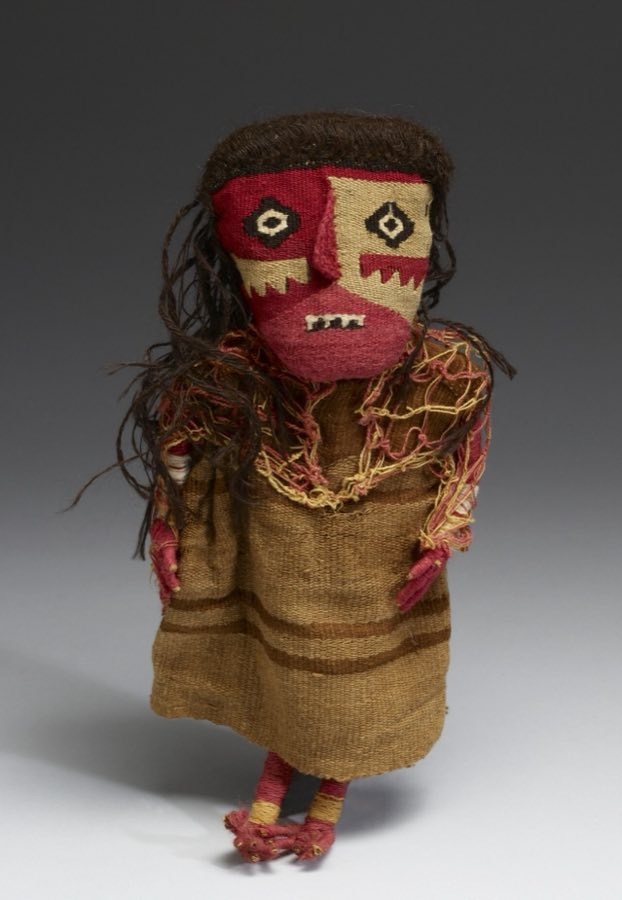

Figurine · Late Intermediate Period
Chancay doll
1000–1470 CE, Chancay
Chancay dolls come from the cemeteries of the Chancay and Huaura valleys north of Lima, where the arid sand preserved textiles from about 1000 to 1470 CE. They accompanied burials and may represent scenes of daily life, since some are grouped as families, weavers or musicians. Their bright dyes and preservation make them a popular collector's item, but export from Peru is prohibited and many were assembled by dealers from loose ancient cloth.
| Object | Figurine |
|---|---|
| Dates | 1000–1470 CE |
| Period | Late Intermediate Period |
| Cultures | Chancay |
| Regions | South America — Andes |
Diagnostic traits
A stuffed figure 150–400 mm tall made of woven cotton and camelid-wool cloth over a reed or cotton core, with an embroidered or tapestry face, often in a group or with a miniature loom, found in the dry cemeteries of Peru's central coast.
Identification
Chancay cloth uses tapestry, gauze and painted plain weave in a limited palette of natural cotton, brown, red, yellow and blue; a doll whose face is machine-stitched, whose fabric is one continuous new weave or whose stuffing is synthetic is modern. Chancay black-on-white 'cuchimilco' figurines are ceramic, not textile.
Reproductions and fakes
The classic problem is the composite: genuine Chancay textile fragments sewn into a modern doll, sometimes with a modern face. Look at every seam for new thread, and expect an ancient doll to be fragile, faded on one side and slightly musty, never bright and firm.
Cite this article
Stratum Study. "Chancay doll" (Artifact type). Stratum Study pack 2026.09, as of 2026-09-21. https://stratum.black/study/types/chancay-doll. Accessed 2026-09-21.
@misc{stratum-chancay-doll,
  title        = {Chancay doll},
  author       = {{Stratum Study}},
  howpublished = {\url{https://stratum.black/study/types/chancay-doll}},
  year         = {2026},
  note         = {Artifact type article, Stratum Study pack 2026.09, as of 2026-09-21; sources: stratum, commons. Accessed 2026-09-21.}
}
Citations carry the pack version and the article's as-of date so they resolve to the same text later. The facts themselves belong to the sources listed below; cite those for the science.