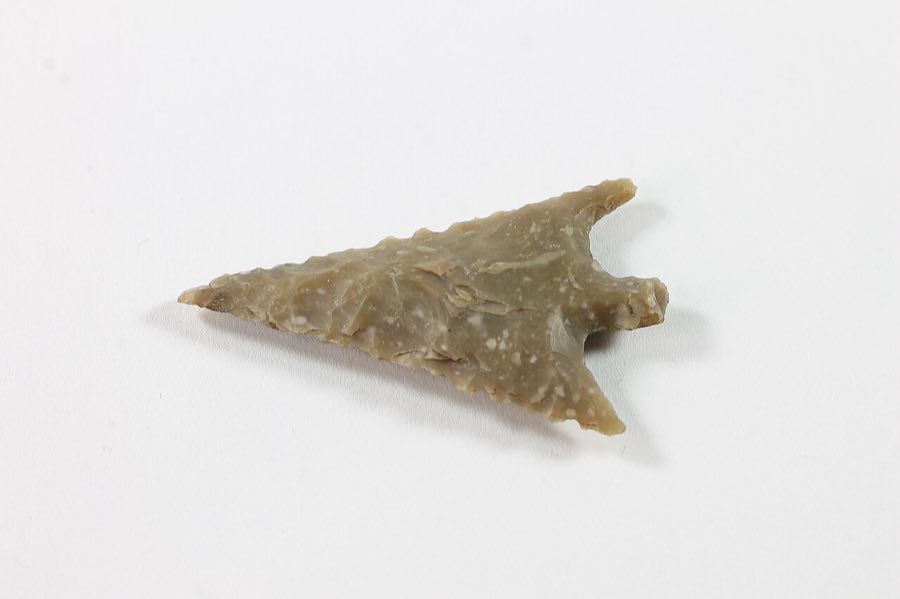

Projectile point · Early Bronze Age
Barbed-and-tanged arrowhead
2500–1500 BCE, Bell Beaker
The barbed-and-tanged arrowhead is the flint arrowhead of the Beaker and Early Bronze Age in Britain and western Europe, about 2,500 to 1,500 BCE, with a central tang and two barbs. It is common on Bronze Age sites and fields and was placed in Beaker graves. Fine examples such as Breton and Kilmarnock types are prized.
| Object | Projectile point |
|---|---|
| Dates | 2500–1500 BCE |
| Period | Early Bronze Age |
| Cultures | Bell Beaker |
| Regions | Europe — Northern & British Isles, Europe — Western & Central |
Diagnostic traits
Bifacially flaked flint arrowhead with a central tang flanked by two barbs; fine examples have squared barbs.
Identification
The tang and barbs distinguish it from Neolithic leaf-shaped and transverse arrowheads and from the later hollow-based form; Sutton, Conygar Hill and Green Low types are defined by barb and tang shape. Flaking is bifacial and invasive. Size is 2 to 5 cm.
Reproductions and fakes
The most reproduced British arrowhead, with modern knappers producing very fine examples; look for fresh unpatinated flint, overly symmetrical barbs and no edge wear. Genuine pieces on chalk flint usually have a white patina.
Elsewhere
- Wikidata: Q111240702
Cite this article
Stratum Study. "Barbed-and-tanged arrowhead" (Artifact type). Stratum Study pack 2026.09, as of 2026-09-21. https://stratum.black/study/types/barbed-and-tanged-arrowhead. Accessed 2026-09-21.
@misc{stratum-barbed-and-tanged-arrowhead,
  title        = {Barbed-and-tanged arrowhead},
  author       = {{Stratum Study}},
  howpublished = {\url{https://stratum.black/study/types/barbed-and-tanged-arrowhead}},
  year         = {2026},
  note         = {Artifact type article, Stratum Study pack 2026.09, as of 2026-09-21; sources: stratum, wikidata, commons. Accessed 2026-09-21.}
}
Citations carry the pack version and the article's as-of date so they resolve to the same text later. The facts themselves belong to the sources listed below; cite those for the science.