

Shark / ray
Otodus megalodon
Megalodon
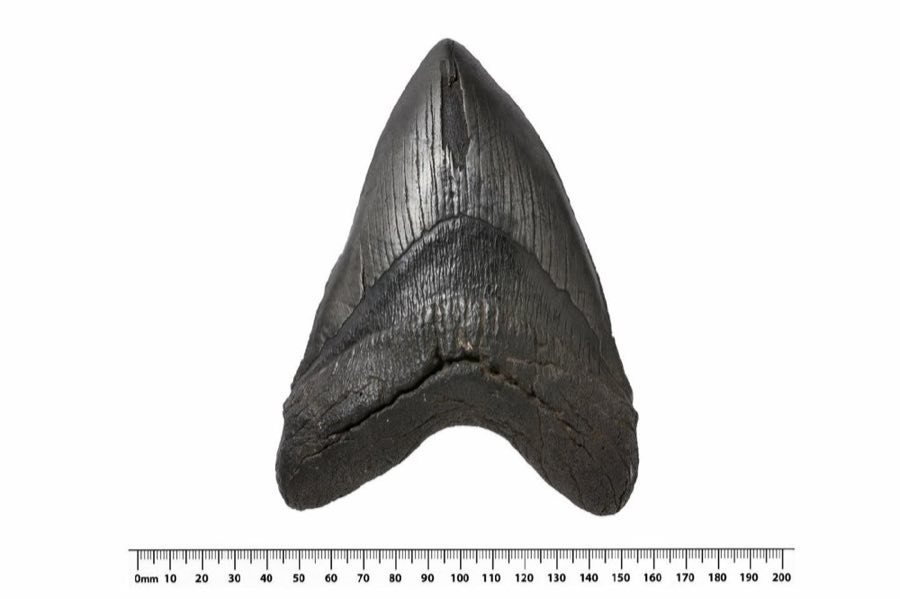
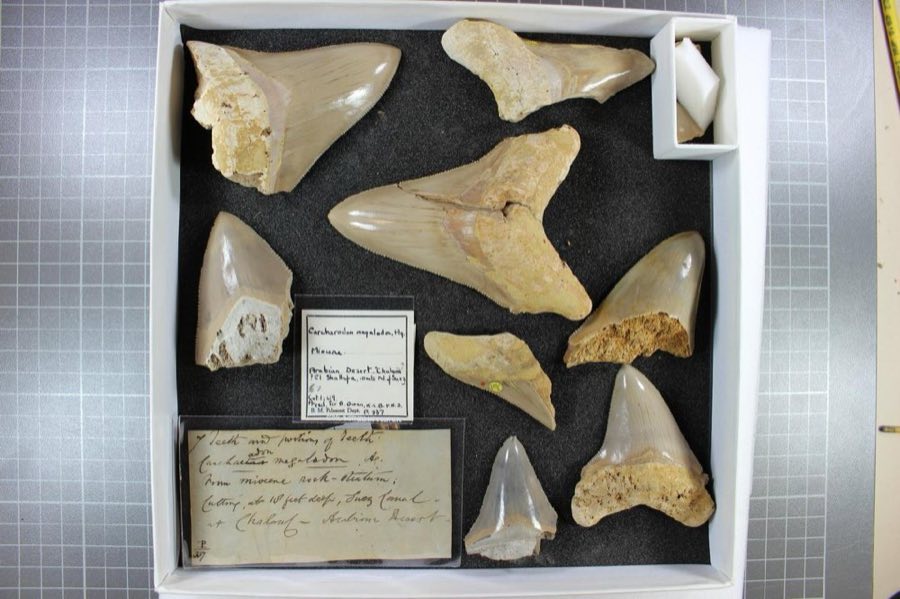
Otodus megalodon (also Carcharocles megalodon) is the giant Miocene–Pliocene shark whose broad, serrated triangular teeth with a chevron-shaped bourlette are the most collected vertebrate fossil in the world. Colour and value depend on locality: Bone Valley tan-and-blue mine teeth and Lee Creek grey teeth command the highest prices, river teeth from the Peace and Cooper rivers are black and cheaper, and Indonesian and Chilean teeth have flooded the market since the 2000s. Size is measured on the slant (diagonal) and every quarter inch above five inches adds sharply to the price.
| Phylum | Chordata |
|---|---|
| Class | Chondrichthyes |
| Order | Lamniformes |
| Family | Otodontidae |
| Group | Shark / ray |
| Size | teeth to 18 cm; body 15–20 m |
| Rank (PBDB) | species· Paleobiology Database |
| Author | (Agassiz 1835)· Paleobiology Database |
| Common name (PBDB) | megalodon· Paleobiology Database |
| Classification (PBDB) | Chordata › Chondrichthyes › Lamniformes › Otodontidae· Paleobiology Database |
| Range (PBDB) | 66–0.34 Ma· Paleobiology Database |
| PBDB occurrences | 347· Paleobiology Database |
Restoration and fakes
Tip, serration, bourlette and root repair are routine and often undisclosed; look for colour breaks and resin under UV, and ask specifically whether the tooth is 'natural' (unrepaired). Composite teeth built from several fragments and 'enhanced' polished teeth should be sold as such.
Photographs
Elsewhere
- GBIF: 8566942
- PBDB: 381671
- Wikidata: Q163873
- PBDB taxon page
- Wikipedia: megalodon
- PBDB search: Otodus
Cite this article
Stratum Study. "Otodus megalodon" (Taxon). Stratum Study pack 2026.09, as of 2026-09-19. https://stratum.black/study/taxa/otodus-megalodon. Accessed 2026-09-20.
@misc{stratum-otodus-megalodon,
  title        = {Otodus megalodon},
  author       = {{Stratum Study}},
  howpublished = {\url{https://stratum.black/study/taxa/otodus-megalodon}},
  year         = {2026},
  note         = {Taxon article, Stratum Study pack 2026.09, as of 2026-09-19; sources: stratum, pbdb, wikidata, commons, nhm. Accessed 2026-09-20.}
}
Citations carry the pack version and the article's as-of date so they resolve to the same text later. The facts themselves belong to the sources listed below; cite those for the science.