
Site · China
Terracotta Army
Imperial China, 246–206 BCE
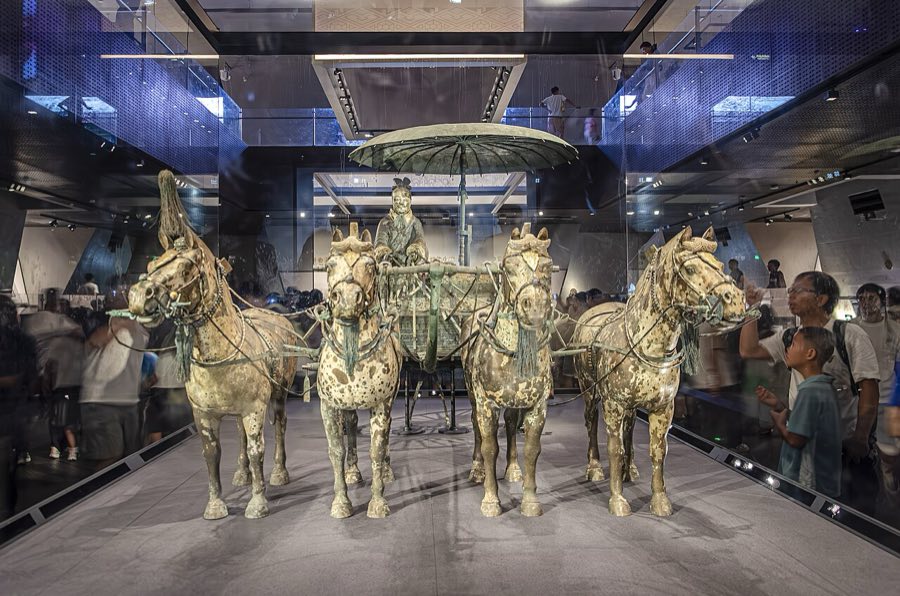
The First Emperor's mausoleum near Xi'an was built between 246 and 208 BCE with a buried army guarding the eastern approach to the tomb mound, which Sima Qian described as containing rivers of mercury and which remains sealed. The figures were mass-produced from moulded parts with individual finishing and were originally painted. The site is China's most visited archaeological attraction.
| Country | China |
|---|---|
| Dates | 246–206 BCE |
| Status | National Key Cultural Relics Protection Unit and UNESCO World Heritage Site (1987) |
| Managed by | Emperor Qinshihuang's Mausoleum Site Museum |
| Access | Open daily near Lintong east of Xi'an; the three excavated pits are under hangars with walkways, and the mound of the tomb itself is unexcavated. |
| Coordinates | 34.385, 109.278 (public site) |
What was found
Discovery by well-diggers in 1974 led to the excavation of three pits with some 8,000 life-sized terracotta soldiers, horses and chariots, bronze weapons with chrome-treated surfaces, and later the bronze chariots, terracotta acrobats, stone armour and the tombs of officials and workers around the mound.
Rules
Nothing may be collected; China's Law on the Protection of Cultural Relics makes all buried relics state property and forbids their export, and the United States has restricted import of Chinese archaeological material under a CPIA agreement since 2009. This article is for study and context only and is not a collecting locality.
Elsewhere
Cite this article
Stratum Study. "Terracotta Army" (Site). Stratum Study pack 2026.09, as of 2026-09-21. https://stratum.black/study/sites/terracotta-army. Accessed 2026-09-21.
@misc{stratum-terracotta-army,
  title        = {Terracotta Army},
  author       = {{Stratum Study}},
  howpublished = {\url{https://stratum.black/study/sites/terracotta-army}},
  year         = {2026},
  note         = {Site article, Stratum Study pack 2026.09, as of 2026-09-21; sources: stratum, commons. Accessed 2026-09-21.}
}
Citations carry the pack version and the article's as-of date so they resolve to the same text later. The facts themselves belong to the sources listed below; cite those for the science.