
Site · United States
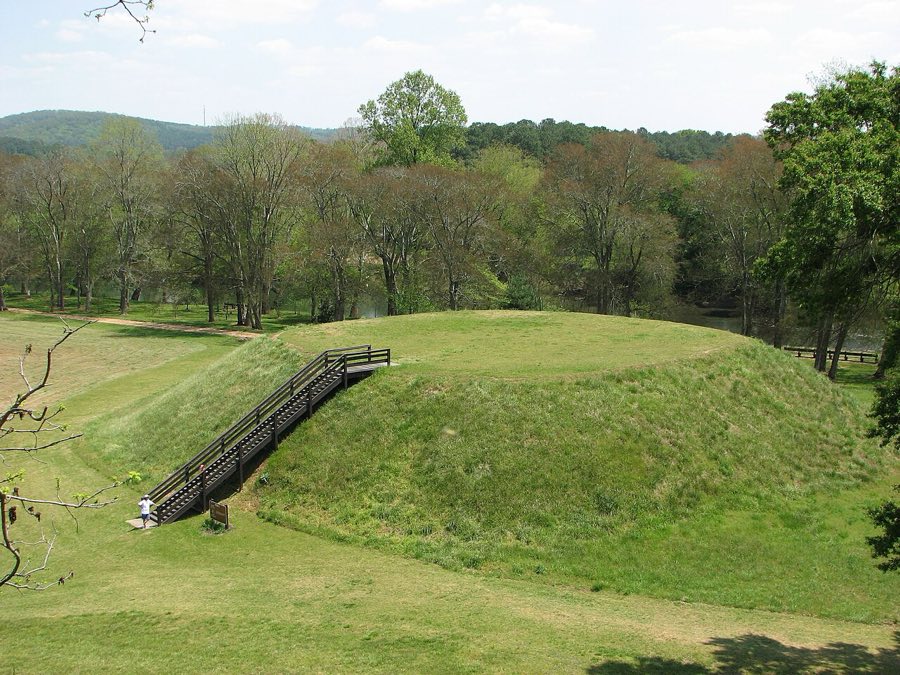
Etowah Indian Mounds
Mississippian, 1000–1550 CE
Etowah is a Mississippian chiefdom centre of three large mounds and a plaza on the Etowah River in northwest Georgia, occupied in phases between about 1000 and 1550. It was fortified with a ditch and palisade and is the type site for Etowah pottery.
| Country | United States |
|---|---|
| State / province | Georgia |
| Dates | 1000–1550 CE |
| Status | State Historic Site and National Historic Landmark |
| Managed by | Georgia Department of Natural Resources |
| Access | Open to the public with a museum and mound trail |
| Coordinates | 34.126, -84.809 (public site) |
What was found
Mound C yielded the marble ancestor statues, copper plates with falcon dancers, engraved shell gorgets, monolithic axes and stone palettes that define the Southeastern Ceremonial Complex. Village debris includes Etowah Complicated Stamped pottery and triangular points.
Rules
Nothing may be collected, dug, moved or removed at Etowah Indian Mounds; it is a protected archaeological site managed by Georgia Department of Natural Resources, and taking artifacts, stones or samples is an offence. Federal, state and tribal law, including ARPA and NAGPRA where applicable, protect the site and its burials. This article is for study and context only and is not a collecting locality.
Elsewhere
Cite this article
Stratum Study. "Etowah Indian Mounds" (Site). Stratum Study pack 2026.09, as of 2026-09-21. https://stratum.black/study/sites/etowah-indian-mounds. Accessed 2026-09-21.
@misc{stratum-etowah-indian-mounds,
  title        = {Etowah Indian Mounds},
  author       = {{Stratum Study}},
  howpublished = {\url{https://stratum.black/study/sites/etowah-indian-mounds}},
  year         = {2026},
  note         = {Site article, Stratum Study pack 2026.09, as of 2026-09-21; sources: stratum, wikidata, commons. Accessed 2026-09-21.}
}
Citations carry the pack version and the article's as-of date so they resolve to the same text later. The facts themselves belong to the sources listed below; cite those for the science.