
Shell · Class
Polyplacophora
Chitons
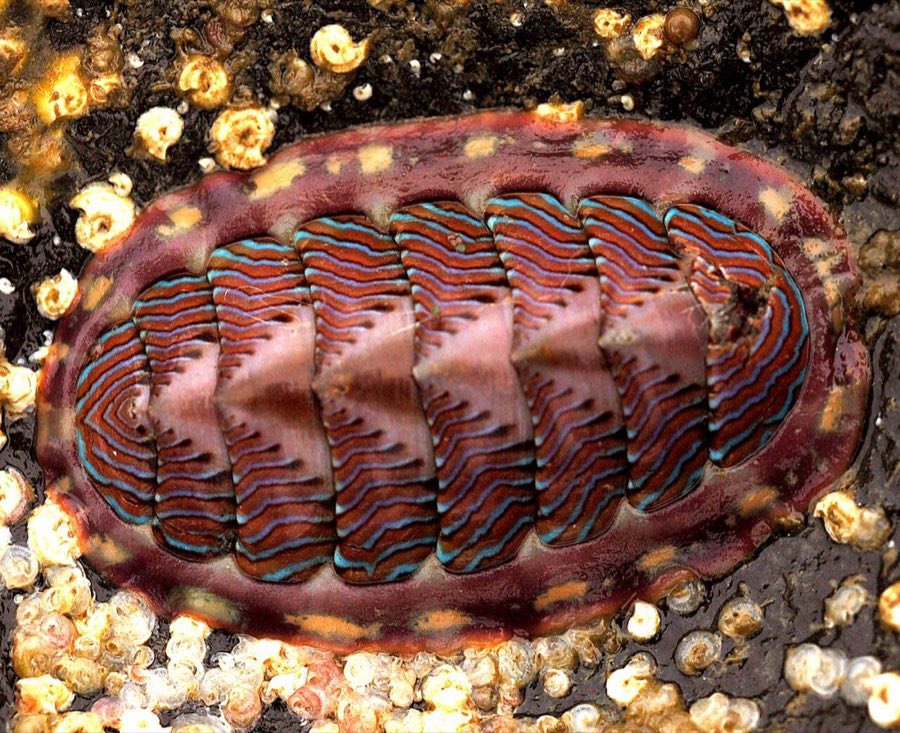
Chitons (class Polyplacophora) are molluscs with eight overlapping shell plates held in a leathery girdle, grazing algae on rocks; the gumboot chiton Cryptochiton stelleri of the Pacific Northwest reaches 30 cm. Collectors keep the separated 'butterfly' plates or whole flattened specimens dried on a board. Fossil chiton plates occur from the Cambrian.
| Habitat | Rocky intertidal and subtidal, worldwide |
|---|---|
| Regions | Worldwide |
| Family | Chitonidae and others |
| Authority (WoRMS) | Gray, 1821· WoRMS / MolluscaBase |
| Status (WoRMS) | accepted· WoRMS / MolluscaBase |
| Extinct (WoRMS) | no· WoRMS / MolluscaBase |
| Classification (WoRMS) | Animalia › Mollusca › Polyplacophora· WoRMS / MolluscaBase |
CITES and protection
Not CITES-listed; the giant gumboot chiton is protected in some US states.
Care (Byne's disease)
Disarticulated plates are stable; whole dried chitons curl and crack.
Elsewhere
- WoRMS AphiaID: 55
- Wikidata: Q188906
- WoRMS / MolluscaBase record
- Wikipedia: Polyplacophora
- CITES Appendices
Cite this article
Stratum Study. "Polyplacophora" (Shell family). Stratum Study pack 2026.09, as of 2026-09-19. https://stratum.black/study/shells/polyplacophora. Accessed 2026-09-20.
@misc{stratum-polyplacophora,
  title        = {Polyplacophora},
  author       = {{Stratum Study}},
  howpublished = {\url{https://stratum.black/study/shells/polyplacophora}},
  year         = {2026},
  note         = {Shell family article, Stratum Study pack 2026.09, as of 2026-09-19; sources: stratum, worms, wikidata, commons. Accessed 2026-09-20.}
}
Citations carry the pack version and the article's as-of date so they resolve to the same text later. The facts themselves belong to the sources listed below; cite those for the science.