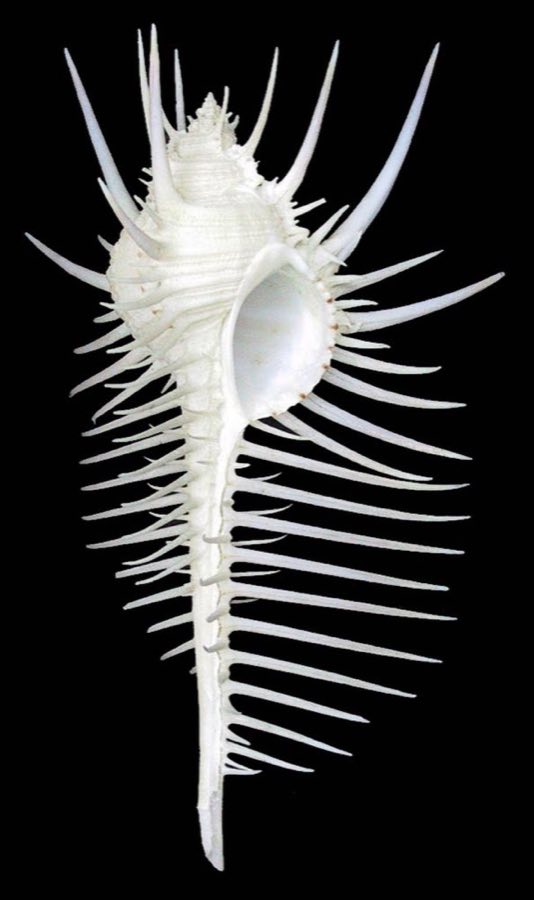

Shell · Family (muricidae)
Murex
Murex and rock shells
Muricids include Murex (the spiny 'Venus comb', Murex pecten), Chicoreus (frilled and branched spines), Hexaplex and Phyllonotus, all predatory snails that drill other molluscs. Spines are the value: an unbroken Venus comb or a well-frilled Chicoreus ramosus commands a premium, and broken spines are sometimes repaired or replaced. Specimens should be sold with all repairs disclosed.
| Habitat | Rocky and sandy bottoms, intertidal to continental shelf, worldwide |
|---|---|
| Regions | Indo-Pacific, Mediterranean, Caribbean, West Africa, Eastern Pacific |
| Family | Muricidae |
| Authority (WoRMS) | Rafinesque, 1815· WoRMS / MolluscaBase |
| Status (WoRMS) | accepted· WoRMS / MolluscaBase |
| Classification (WoRMS) | Animalia › Mollusca › Gastropoda › Neogastropoda › Muricidae· WoRMS / MolluscaBase |
CITES and protection
No muricids are CITES-listed; Murex was the source of Tyrian purple and several Mediterranean species are locally regulated as food.
Care (Byne's disease)
The long spines of Murex and Chicoreus trap humidity and salts; rinse thoroughly in fresh water before storage and keep away from wooden drawers.
Elsewhere
- WoRMS AphiaID: 148
- Wikidata: Q311512
- WoRMS / MolluscaBase record
- Wikipedia: Murex
- CITES Appendices
Cite this article
Stratum Study. "Murex" (Shell family). Stratum Study pack 2026.09, as of 2026-09-19. https://stratum.black/study/shells/murex. Accessed 2026-09-20.
@misc{stratum-murex,
  title        = {Murex},
  author       = {{Stratum Study}},
  howpublished = {\url{https://stratum.black/study/shells/murex}},
  year         = {2026},
  note         = {Shell family article, Stratum Study pack 2026.09, as of 2026-09-19; sources: stratum, worms, wikidata, commons. Accessed 2026-09-20.}
}
Citations carry the pack version and the article's as-of date so they resolve to the same text later. The facts themselves belong to the sources listed below; cite those for the science.