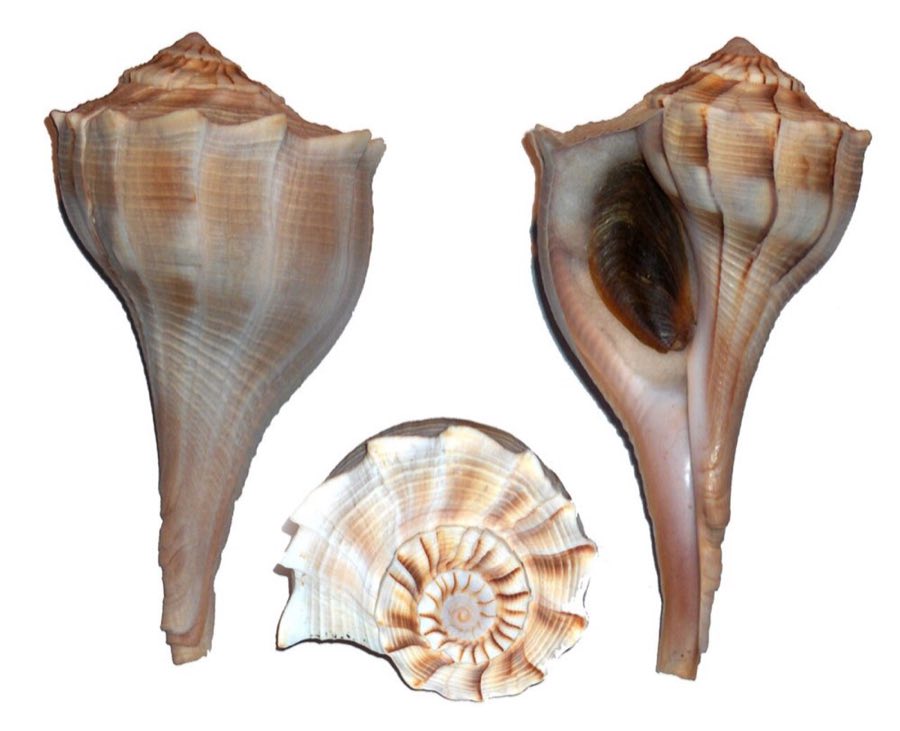

Shell · Genus
Busycon
Whelks (living)
Busycon, Busycotypus and Sinistrofulgur are the knobbed, channelled and lightning whelks of the US east coast, large predatory snails whose shells are the most common big shells on Atlantic beaches; the lightning whelk is left-handed and is the Texas state shell. Their egg-case strings ('mermaid's necklace') wash up too. Fossil Busycon fill the Pliocene beds; see the taxon article.
| Habitat | Sand and mud, shallow western Atlantic |
|---|---|
| Regions | Eastern North America, Gulf of Mexico |
| Family | Busyconidae |
| Authority (WoRMS) | Röding, 1798· WoRMS / MolluscaBase |
| Status (WoRMS) | accepted· WoRMS / MolluscaBase |
| Classification (WoRMS) | Animalia › Mollusca › Gastropoda › Neogastropoda › Busyconidae· WoRMS / MolluscaBase |
CITES and protection
Not CITES-listed; harvested as food.
Care (Byne's disease)
Stable; the thin periostracum flakes.
Elsewhere
- WoRMS AphiaID: 160183
- Wikidata: Q291491
- WoRMS / MolluscaBase record
- Wikipedia: Busycon
- CITES Appendices
Cite this article
Stratum Study. "Busycon" (Shell family). Stratum Study pack 2026.09, as of 2026-09-19. https://stratum.black/study/shells/busycon. Accessed 2026-09-20.
@misc{stratum-busycon,
  title        = {Busycon},
  author       = {{Stratum Study}},
  howpublished = {\url{https://stratum.black/study/shells/busycon}},
  year         = {2026},
  note         = {Shell family article, Stratum Study pack 2026.09, as of 2026-09-19; sources: stratum, worms, wikidata, commons. Accessed 2026-09-20.}
}
Citations carry the pack version and the article's as-of date so they resolve to the same text later. The facts themselves belong to the sources listed below; cite those for the science.