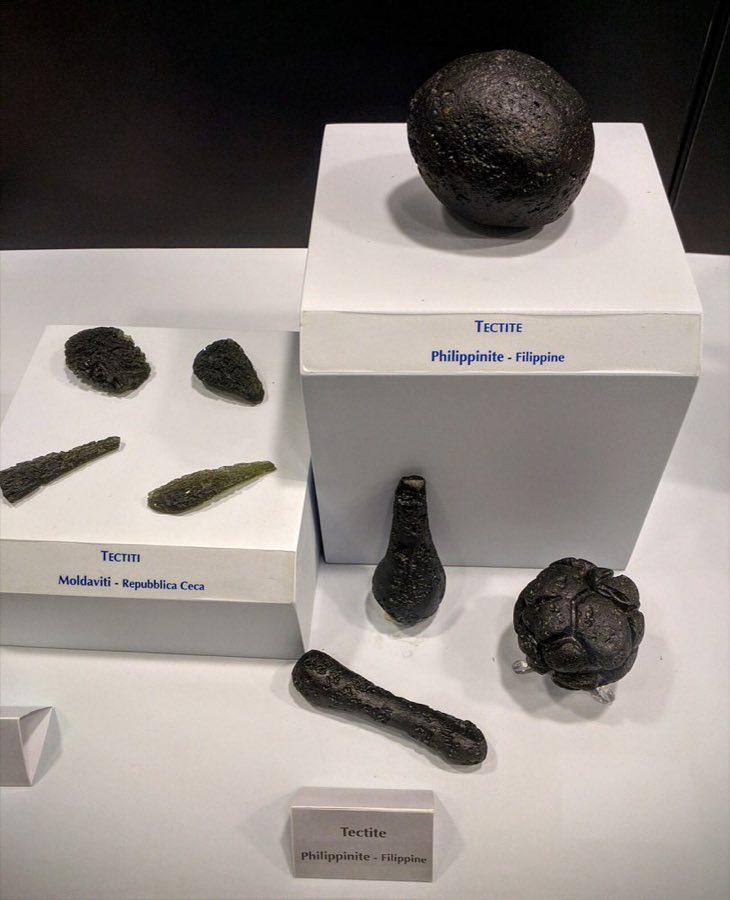

Mineraloid · Tektite
Tektite
SiO2-rich impact glass
Tektites are natural glasses ejected from meteorite impacts: black indochinites from Thailand, Vietnam and China (the largest strewn field, 790,000 years old), button-shaped australites, Ivory Coast tektites, Georgia and Texas (bediasite) tektites, and the yellow Libyan desert glass of Egypt. Indochinites are cheap and sold by weight; australites and bediasites are rarer. They are not meteorites, but are the terrestrial glass a meteorite produced.
| Formula | SiO2-rich impact glass |
|---|---|
| IMA status | mineraloid |
| Crystal system | Amorphous |
| Mohs hardness | 5.5–6.5 |
| Group | Tektite |
| Type locality | None |
Fakes and treatments
Indochinites are widely imitated in glass; genuine ones have pitted, grooved surfaces and no bubbles at the surface. Libyan desert glass is imitated with yellow bottle glass.
Elsewhere
- Wikidata: Q468438
- Wikipedia: tektite
- Mindat: Tektite
Cite this article
Stratum Study. "Tektite" (Mineral). Stratum Study pack 2026.09, as of 2026-09-19. https://stratum.black/study/minerals/tektite. Accessed 2026-09-20.
@misc{stratum-tektite,
  title        = {Tektite},
  author       = {{Stratum Study}},
  howpublished = {\url{https://stratum.black/study/minerals/tektite}},
  year         = {2026},
  note         = {Mineral article, Stratum Study pack 2026.09, as of 2026-09-19; sources: stratum, wikidata, commons. Accessed 2026-09-20.}
}
Citations carry the pack version and the article's as-of date so they resolve to the same text later. The facts themselves belong to the sources listed below; cite those for the science.