
Mineral group · Serpentine group
Chrysotile
Mg3Si2O5(OH)4
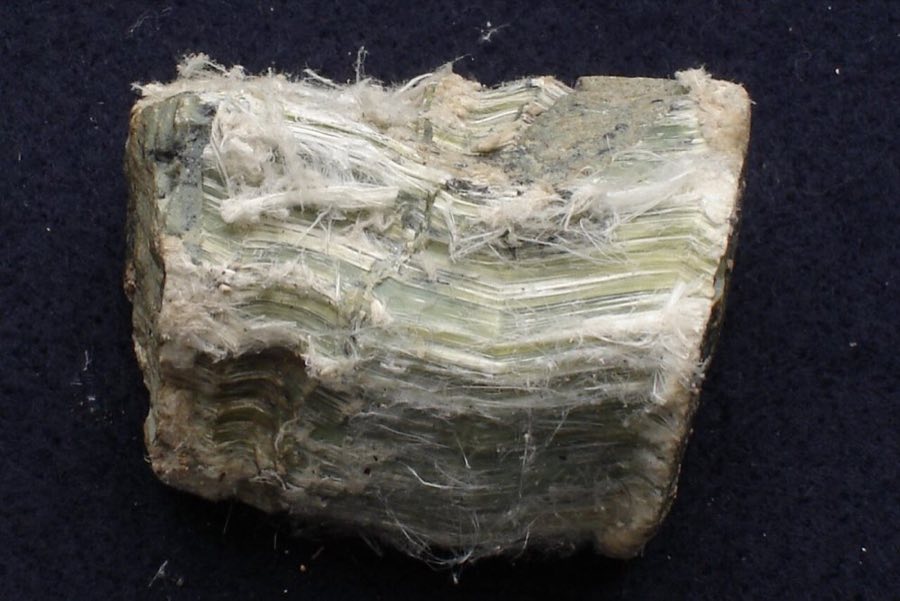
Chrysotile is the fibrous serpentine that made up 95 % of the asbestos used in industry, found as silky cross-fibre veins at Asbestos and Thetford (Quebec), Arizona and Russia. It is a genuine mineral of historical interest that many collections hold in old specimens; it is also a carcinogen when fibres are inhaled. Store sealed, never break or handle dry, and consider whether to sell it at all.
| Formula | Mg3Si2O5(OH)4 |
|---|---|
| IMA status | group |
| Crystal system | Monoclinic (clinochrysotile) |
| Mohs hardness | 2.5 |
| Group | Serpentine group |
| Type locality | None |
| Streak | White |
| Specific gravity | 2.5 |
Handling and safety
Regulated asbestos; some jurisdictions restrict sale. Keep sealed in a rigid container and label clearly.
Elsewhere
Cite this article
Stratum Study. "Chrysotile" (Mineral). Stratum Study pack 2026.09, as of 2026-09-19. https://stratum.black/study/minerals/chrysotile. Accessed 2026-09-20.
@misc{stratum-chrysotile,
  title        = {Chrysotile},
  author       = {{Stratum Study}},
  howpublished = {\url{https://stratum.black/study/minerals/chrysotile}},
  year         = {2026},
  note         = {Mineral article, Stratum Study pack 2026.09, as of 2026-09-19; sources: stratum, wikidata, commons. Accessed 2026-09-20.}
}
Citations carry the pack version and the article's as-of date so they resolve to the same text later. The facts themselves belong to the sources listed below; cite those for the science.