
Mineral · Phyllosilicate
Chrysocolla
Cu2-xAlx(H2-xSi2O5)(OH)4·nH2O
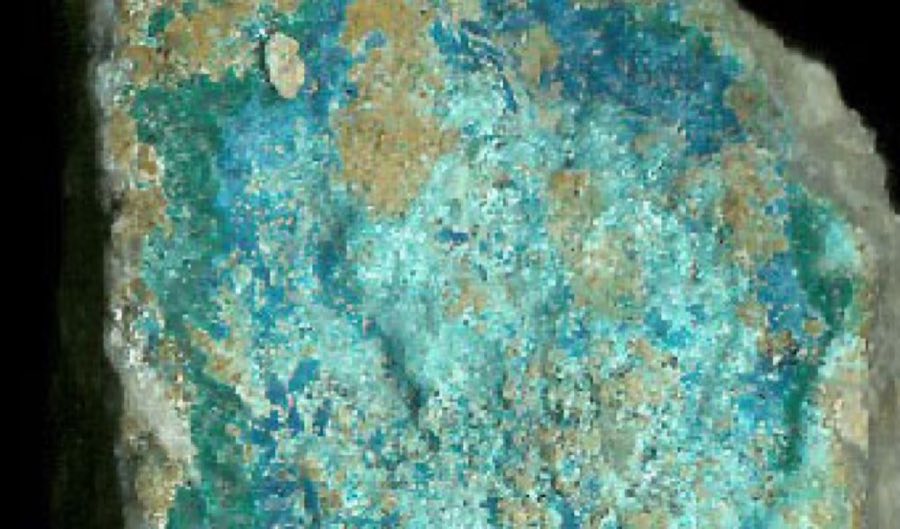
Chrysocolla is a blue-green hydrated copper silicate forming crusts and botryoidal masses in the oxidised zones of copper deposits in Arizona, Congo, Israel (Eilat stone) and Peru. Soft chrysocolla is fragile; 'gem silica' is chrysocolla-impregnated chalcedony from the Inspiration Mine and is hard and valuable. It is often confused with turquoise.
| Formula | Cu2-xAlx(H2-xSi2O5)(OH)4·nH2O |
|---|---|
| IMA status | approved |
| Crystal system | Orthorhombic |
| Mohs hardness | 2.5–3.5 |
| Group | Phyllosilicate |
| Type locality | None (known since antiquity) |
| Streak | Pale blue-green |
| Specific gravity | 2.0–2.4 |
| Reference list | IMA List of Minerals (RRUFF) — verify formula and status against the current list |
Fakes and treatments
Chrysocolla is stabilised with resin for cutting; blue-green chalcedony and dyed howlite are sold as chrysocolla or turquoise.
Elsewhere
Cite this article
Stratum Study. "Chrysocolla" (Mineral). Stratum Study pack 2026.09, as of 2026-09-19. https://stratum.black/study/minerals/chrysocolla. Accessed 2026-09-20.
@misc{stratum-chrysocolla,
  title        = {Chrysocolla},
  author       = {{Stratum Study}},
  howpublished = {\url{https://stratum.black/study/minerals/chrysocolla}},
  year         = {2026},
  note         = {Mineral article, Stratum Study pack 2026.09, as of 2026-09-19; sources: stratum, wikidata, commons. Accessed 2026-09-20.}
}
Citations carry the pack version and the article's as-of date so they resolve to the same text later. The facts themselves belong to the sources listed below; cite those for the science.