
Locality · Pay-to-dig visitor quarries; working quarries private
Solnhofen and Eichstätt quarries
Eichstätt / Weißenburg-Gunzenhausen, Bavaria, Germany
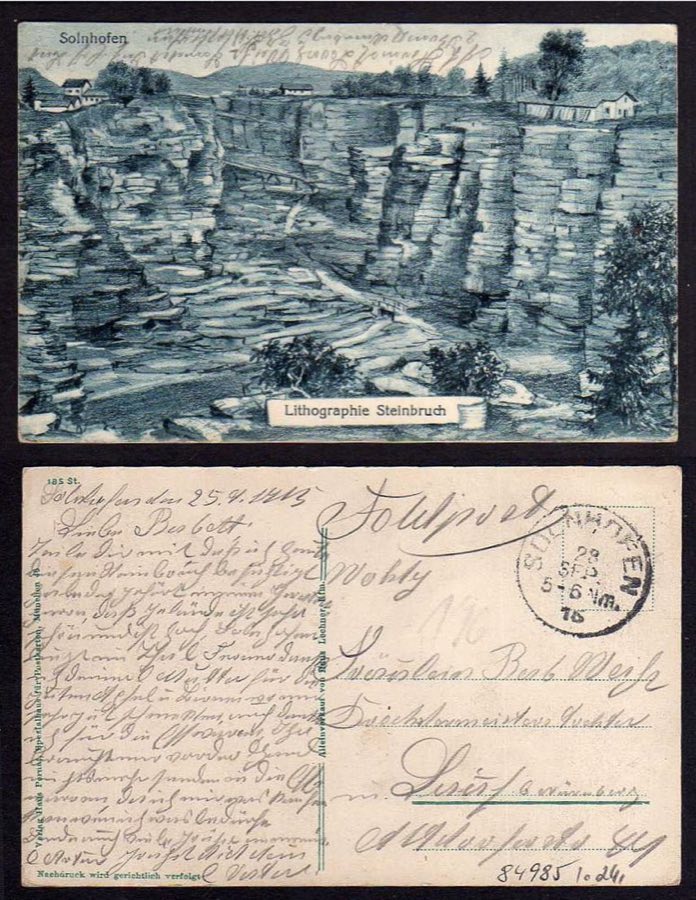
The Plattenkalk quarries around Solnhofen, Eichstätt and Mörnsheim in Bavaria sell dig-your-own days in dedicated visitor quarries, where splitting the thin limestone yields Saccocoma, dendrites, small fish and shrimps, while the working quarries supply the professional trade. The Museum Solnhofen and Jura-Museum Eichstätt display Archaeopteryx and pterosaurs. It is an easy, legal way to collect a Solnhofen fossil, and the quarry name belongs on the label.
| Country | Germany |
|---|---|
| State / province | Bavaria |
| County | Eichstätt / Weißenburg-Gunzenhausen |
| Land manager / status | Private quarry companies; municipal visitor quarries (Besuchersteinbruch) |
| Access | Visitor quarries at Solnhofen, Eichstätt (Blumenberg) and Mörnsheim charge a small fee and lend tools; seasonal |
| Formations | Solnhofen Limestone |
| What is found | Saccocoma, Leptolepides, dendrites, ammonites, shrimp, rare fish |
| Coordinates (public site) | 48.9, 10.99 |
Rules
Visitor quarries: pay the fee, split slabs by hand, keep what you find; the quarry reserves scientifically important finds (vertebrates) and Bavaria's Denkmalschutz law can claim exceptional specimens. Working lithographic quarries are private and off limits.
Source: https://www.museum-solnhofen.de/ (checked 2026-09-16).
Collecting rules
Elsewhere
Cite this article
Stratum Study. "Solnhofen and Eichstätt quarries" (Locality). Stratum Study pack 2026.09, as of 2026-09-19. https://stratum.black/study/localities/solnhofen-and-eichstatt-quarries. Accessed 2026-09-20.
@misc{stratum-solnhofen-and-eichstatt-quarries,
  title        = {Solnhofen and Eichstätt quarries},
  author       = {{Stratum Study}},
  howpublished = {\url{https://stratum.black/study/localities/solnhofen-and-eichstatt-quarries}},
  year         = {2026},
  note         = {Locality article, Stratum Study pack 2026.09, as of 2026-09-19; sources: stratum, commons. Accessed 2026-09-20.}
}
Citations carry the pack version and the article's as-of date so they resolve to the same text later. The facts themselves belong to the sources listed below; cite those for the science.