
Formation · Silurian
Waldron Shale
Wenlock unit, Indiana · Tennessee
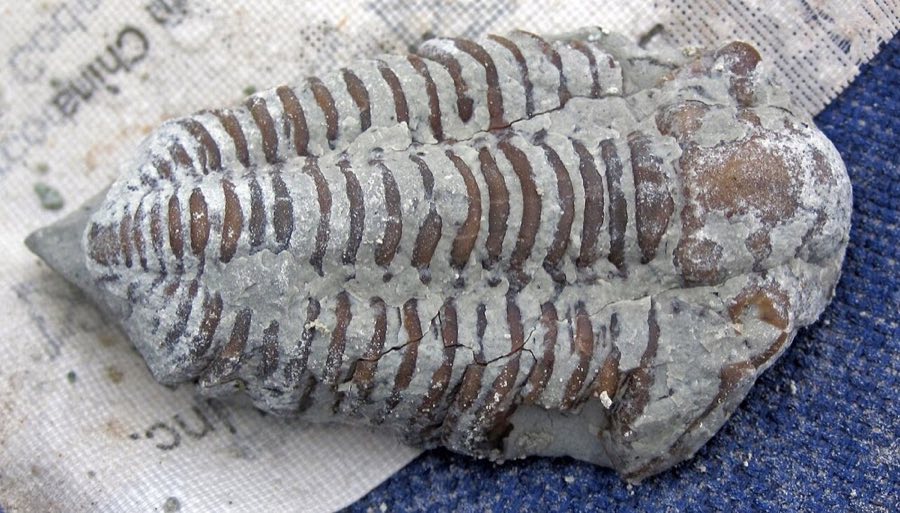
The Waldron Shale of southern Indiana is a Middle Silurian shale famous since the 1860s for Calymene and Dalmanites trilobites, the crinoid Eucalyptocrinites, brachiopods, bryozoans and the chain coral Halysites. Complete Calymene niagarensis from Waldron are the finest American examples of the genus. New material is hard to obtain, so most trade pieces are old collection stock; check for restored cephalons and tails.
| Country | United States |
|---|---|
| Region | Indiana, Tennessee |
| Age | Sheinwoodian, Wenlock |
| Age range | ~433–427 Ma |
| Macrostrat rank | Fm· Macrostrat |
| Macrostrat age | 443–420 Ma· Macrostrat |
| PBDB collections | 31 collections, 574 occurrences· Paleobiology Database |
Collecting and legality
The type area is around Waldron and St. Paul, Indiana, in working limestone quarries (Berry Materials, Irving Materials) that occasionally host club field trips; otherwise private land. No state fossil law applies to private land in Indiana.
Lithology and setting
Blue-grey calcareous shale and thin limestones of a Silurian inter-reef lagoon.
Commonly recorded taxa (PBDB)
Genera most often recorded from this unit in the Paleobiology Database (first 200 occurrences): Eucalyptocrinites (8), Stegerhynchus (8), Atrypa (6), Dimerocrinites (6), Calymene (5), Resserella (5), Anastrophia (4), Dalejina (4), Dicoelosia (4), Eodictyonella (4), Eospirifer (4), Homoeospira (4), Howellella (Howellella) (4), Leptaena (4), Meristina (4).
Source: Paleobiology Database
Elsewhere
- Macrostrat: 66260
- macrostratConcept: 4273
- PBDB: strata:Waldron
- Wikidata: Q18394351
- Macrostrat stratigraphic name
- PBDB occurrences for this unit
- Wikipedia: Waldron Shale
- Mindat: Waldron Shale
Cite this article
Stratum Study. "Waldron Shale" (Formation). Stratum Study pack 2026.09, as of 2026-09-19. https://stratum.black/study/formations/waldron-shale. Accessed 2026-09-20.
@misc{stratum-waldron-shale,
  title        = {Waldron Shale},
  author       = {{Stratum Study}},
  howpublished = {\url{https://stratum.black/study/formations/waldron-shale}},
  year         = {2026},
  note         = {Formation article, Stratum Study pack 2026.09, as of 2026-09-19; sources: stratum, macrostrat, pbdb, wikidata, commons. Accessed 2026-09-20.}
}
Citations carry the pack version and the article's as-of date so they resolve to the same text later. The facts themselves belong to the sources listed below; cite those for the science.