
Culture · Mississippian
Cahokia
1050–1350 CE, North America — Eastern Woodlands
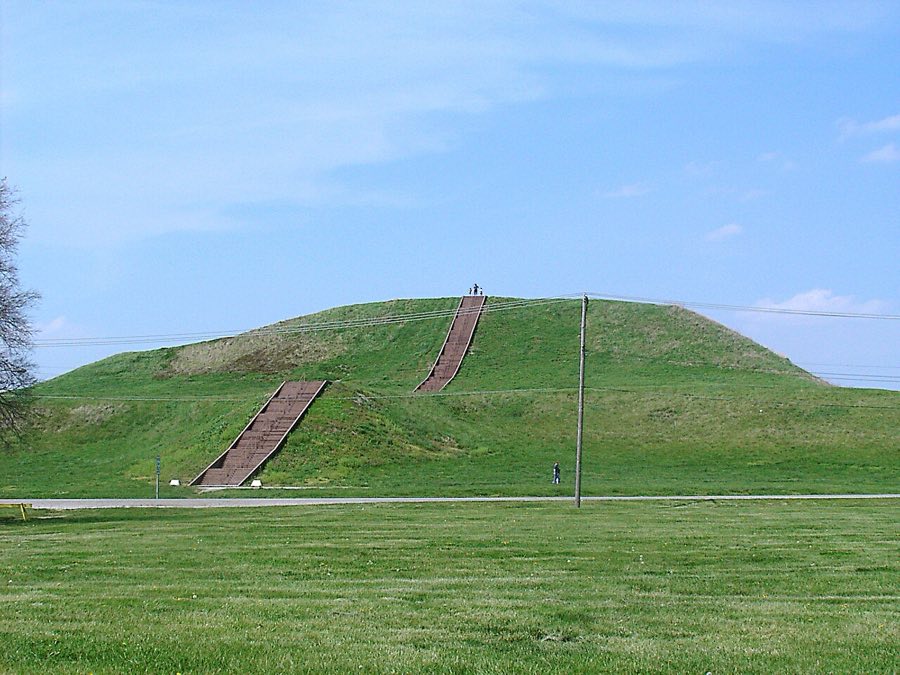
Cahokia was the largest Mississippian centre and the largest pre-Columbian city north of Mexico, occupying the American Bottom opposite modern St. Louis from about 1,050 to 1,350 CE. Its people built Monks Mound, a grand plaza, woodhenges and over a hundred other mounds. Collectors hold Cahokia side-notched arrowpoints, Burlington chert hoes and hoe flakes, Ramey Incised sherds, discoidals and small flint-clay figurines, the last mostly from museum collections.
| Dates | 1050–1350 CE |
|---|---|
| Period | Mississippian |
| Region | North America — Eastern Woodlands |
| Areas | American Bottom, Illinois, Missouri |
| Typical objects | Projectile point, Jar, Discoidal, Figurine |
| Typical materials | Burlington chert, Shell-tempered earthenware, Marine shell, Native copper |
Identification
Cahokia points are small triangles with paired side notches and often a basal notch, finely serrated, usually in white Burlington chert. Ramey Incised jars with angled shoulders and trailed scroll designs, Powell Plain vessels, Mill Creek chert hoes with polished bits and Missouri flint-clay figurines are the other diagnostic objects. Chunkey stones from the region are exceptionally well finished.
Legality
In the United States, prehistoric artifacts may be collected and sold only when they come from private land with the landowner's permission; removal from federal, tribal or most state land is prohibited under ARPA and state statutes. Funerary objects, human remains and sacred items are covered by NAGPRA and are not legitimately traded, and Canadian provinces treat archaeological finds as Crown or provincial property. Cahokia Mounds is an Illinois state historic site and World Heritage property; collecting there is illegal and figurines and burial goods from Mound 72 and similar contexts are NAGPRA material.
Reproductions and fakes
Cahokia side-notched points are faked in Burlington chert because they are small and their form is easy, so watch for notches cut with modern pressure tools that leave sharp, unweathered scars. Flint-clay figurines have been forged in modern clay and pipestone, and Ramey Incised vessels have been reconstructed from disparate sherds.
Elsewhere
- Wikidata: Q333661
- Wikipedia: Cahokia
Cite this article
Stratum Study. "Cahokia" (Culture). Stratum Study pack 2026.09, as of 2026-09-21. https://stratum.black/study/cultures/cahokia. Accessed 2026-09-21.
@misc{stratum-cahokia,
  title        = {Cahokia},
  author       = {{Stratum Study}},
  howpublished = {\url{https://stratum.black/study/cultures/cahokia}},
  year         = {2026},
  note         = {Culture article, Stratum Study pack 2026.09, as of 2026-09-21; sources: stratum, wikidata, commons. Accessed 2026-09-21.}
}
Citations carry the pack version and the article's as-of date so they resolve to the same text later. The facts themselves belong to the sources listed below; cite those for the science.